
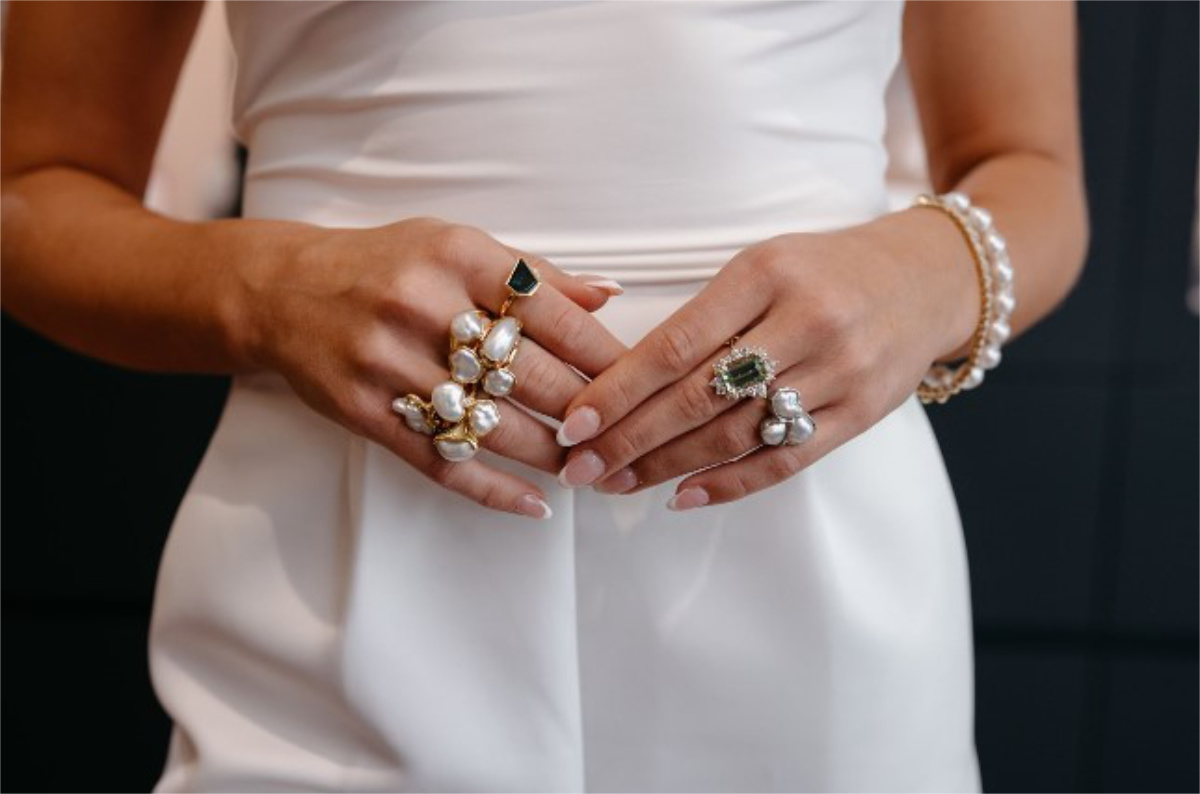
the engagement ring goes on first, the wedding ring sits closest to the heart, and the eternity ring stacks on the outside. From the base of the finger outward, the traditional order is wedding band, engagement ring, then eternity ring.
That said, the convention is older than most modern fingers know what to do with, and a meaningful number of couples now wear their rings in entirely different configurations. The guide below covers the traditional order, where it came from, the modern variations we see most often at our Mt Hawthorn studio in Perth, and the practical questions of stacking, sizing and care that determine whether your three rings work together or fight each other over decades of wear.

The Three-Ring Tradition
The custom of wearing three distinctive rings (an engagement ring, a wedding ring, and an eternity ring) carries roots much older than the modern bridal industry. The Romans believed a vein called the vena amoris ran directly from the fourth finger of the left hand to the heart, which is why the traditional ring finger sits where it does. Roman tradition also involved small iron keys worn by brides as betrothal markers, the structural ancestor of the modern engagement ring.
The ancient Greeks shaped much of the symbolism that survives today. The circular shape represents continuity without beginning or end, which is part of why eternal love and infinity rings carry the meaning they do. The diamond engagement ring tradition itself runs more recently through European aristocracy, with diamond rings becoming markers of a prospective spouse from the Middle Ages onward and entering the mainstream through Queen Victoria’s nineteenth-century preference for diamond jewellery.
The eternity ring is the most recent addition to the trio, popularised in twentieth-century Western cultures as a marker for milestone wedding anniversaries, the birth of a first child, or other significant milestones in a partnership.
The Three Types Of Rings
Each ring in the trio carries its own purpose, design conventions and gifting moment.

Engagement Rings
The engagement ring is typically presented at the proposal. It carries a centre stone, usually a diamond or coloured gemstone, set on a band in 18 carat gold, platinum or another precious metal. The engagement ring stands as the visual marker of the promise that begins the partnership, and its design tends to be the most ornate of the three because it carries the most visible symbolic weight.

Wedding Rings
The wedding ring (sometimes called the wedding band) is exchanged during the wedding ceremony itself. Wedding rings are traditionally worn on the same finger as the engagement ring, and most modern bands are designed in 18 carat gold or 950 platinum to wear well across decades. The wedding band’s relative simplicity, compared to the engagement ring, is part of its design logic: it sits as a continuous metal band that holds its place quietly through daily life.

Eternity Rings
The eternity ring is given to mark significant milestones after the wedding day. Full eternity rings carry a continuous line of identical cut diamonds (or coloured gemstones) around the entire band; half eternity rings carry stones across the front-facing half of the band only. Half eternity designs are easier to resize and sit more comfortably against an existing engagement ring, which is part of why we recommend them more often at the studio than full eternities for daily wear.
What Each Ring Symbolises
The engagement ring symbolises the promise of marriage. Its centre stone is the visual focal point that draws the eye, and the circular shape of the band represents continuity. When a couple chooses a coloured stone (a sapphire, ruby, emerald or Australian pink diamond) rather than a traditional white diamond, the symbolism shifts to incorporate the colour’s own associations.
The wedding ring symbolises the lifelong commitment made during the wedding ceremony itself. The continuous, unbroken pure metal band represents the unbroken nature of the marriage. Many couples engrave the wedding date, initials or a short message inside the band; we cut these by hand at the studio so the inscription ages with the metal rather than wearing flat.
The eternity ring symbolises unending love and the eternal nature of the partnership. The continuous line of stones around the band has no beginning and no end, which is the geometric expression of the relationship’s continuing presence. Eternity rings given for the birth of a first child, a tenth or twenty-fifth wedding anniversary, or another significant milestone carry layered meaning beyond the original wedding vows.
Traditional Ring-Wearing Order
In most Western cultures, the engagement, wedding and eternity rings are all traditionally worn on the fourth finger of the left hand (the left ring finger). The convention follows the Roman ancient belief about the vena amoris connecting that finger to the heart.
The order on the finger, from base outward, is: wedding band closest to the base of the finger (and the heart), then the engagement ring, then the eternity ring on the outside. The logic is that the wedding band, given during the ceremony itself, sits in the position of greatest meaning. The engagement ring (given before the wedding) and the eternity ring (given after) sit on either side.
In practice, this means a bride often slides her engagement ring across to her right hand during the wedding ceremony, then puts the wedding band on first at the altar, and finally returns the engagement ring to its position above the wedding band afterward. Eternity rings added in subsequent years stack on top.
Modern Variations
Modern couples increasingly arrange their rings in configurations that suit their own preferences rather than strict tradition. We see several variations regularly at the studio.
Some wearers swap the order, placing the engagement ring closest to the base of the finger and the wedding band above. This works particularly well when the engagement ring has a low setting that nests neatly against the band.
Others wear two wedding bands flanking the engagement ring, one on each side. This is one of the cleanest solutions for engagement rings with top-heavy centre stones or pronounced halos that need lateral support to stop the ring from rotating on the finger.
Some couples wear the eternity ring on a separate finger entirely or on the right hand, leaving the engagement and wedding rings on the left ring finger by themselves. This suits wearers who want each ring to read as its own piece.
For active lifestyles, some wearers keep the engagement ring at home and wear only the wedding band day to day, reuniting the stack for evenings, weekends and special occasions. There is no incorrect approach. Personal style and personal comfort determine the right answer for each wearer.
Practical Tips For Ring Stacking
Stacking three rings on one finger involves more than just sliding them on in order. A few practical considerations from the studio:
Contoured wedding bands shaped to nest against the engagement ring sit cleaner than straight bands when the engagement ring carries a halo, three stone configuration or low-set centre stone. We design the wedding band against the actual engagement ring at the studio for accurate fit.
Top-heavy engagement rings benefit from two wedding bands rather than one, with the bands sized to flank the engagement ring on either side. The lateral support stops the engagement ring from rotating and keeps the centre stone facing up across daily wear.
Matched metals matter when rings sit against each other across decades. A platinum wedding band worn against an 18 carat gold engagement ring will eventually wear softer marks into the gold because platinum is harder. We recommend matching metal alloys across the stack where possible.
Eternity rings stacked above the engagement ring should be sized slightly looser than the wedding band, because they sit further up the finger where the diameter is fractionally smaller. We size each ring individually against the wearer at the studio.
When To Gift An Eternity Ring
The traditional moments for gifting an eternity ring are the first wedding anniversary, the birth of a first child, a tenth or twenty-fifth wedding anniversary, or any milestone that holds particular meaning for the couple. Some couples prefer to mark smaller, more personal moments (the completion of a major project, the move to a new home, the recovery from a hard year together) rather than the conventional dates.
The eternity ring can be a full or half eternity design, set with diamonds, sapphires, rubies, emeralds or the wearer’s birthstone. Some clients build a series of stackable eternity rings over years, with each band marking a separate moment in the marriage. The accumulating stack becomes its own running record of the relationship.
Caring For Your Three-Ring Set
Three rings worn together across decades need care. We offer free annual cleaning and inspection on every ring we make at our Perth studio, with the rings checked for prong wear, metal wear between the bands, and any structural concerns at the setting level.
At home, wash the rings weekly in warm water with a drop of mild detergent and a soft toothbrush, then dry with a soft cloth. Avoid harsh chemicals, chlorinated pool water and ultrasonic cleaners on softer stones like pearls or opals.
Insurance matters for any meaningful ring stack. We provide full valuation documentation with every ring we make and partner with Q Report Jewellery Insurance for clients who want specialist jewellery cover, with the policy able to direct any replacement or repair work back to the studio.
Personal Choice Comes First
The order in which you wear your engagement, wedding and eternity rings is finally a personal choice rather than a rule. Traditional configurations carry historical weight, but modern variations suit modern wearers, and the configuration that feels right on your hand is the right one for you.
If you are designing a new wedding band to sit alongside an existing engagement ring, or thinking ahead to an eternity ring for a future anniversary, we welcome the conversation in person at our Mt Hawthorn studio. We will size the rings against each other at the studio, walk through the metal and design options, and shape the stack around the wearer rather than the convention.
Talk Through Your Ring Stack At The Studio
Talk Through Your Ring Stack At The Studio at 145 Scarborough Beach Road, Mt Hawthorn, or call us on (08) 9481 0548 to arrange a private appointment to discuss your engagement, wedding and eternity ring configuration.
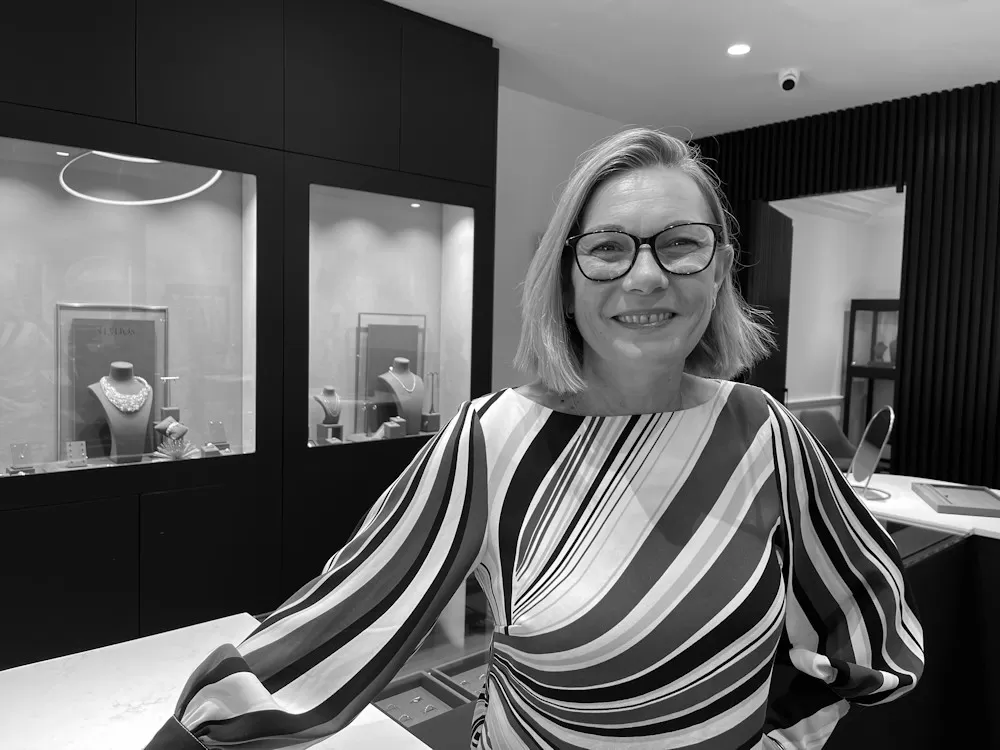
Isabelle Pontis, lead designer at Stelios Jewellers, brings 27 years of experience and a renowned eye for detail. Her bespoke designs blend technical mastery with artistic vision, shaping the signature style and quality of Stelios Jewellers.



Social Media