
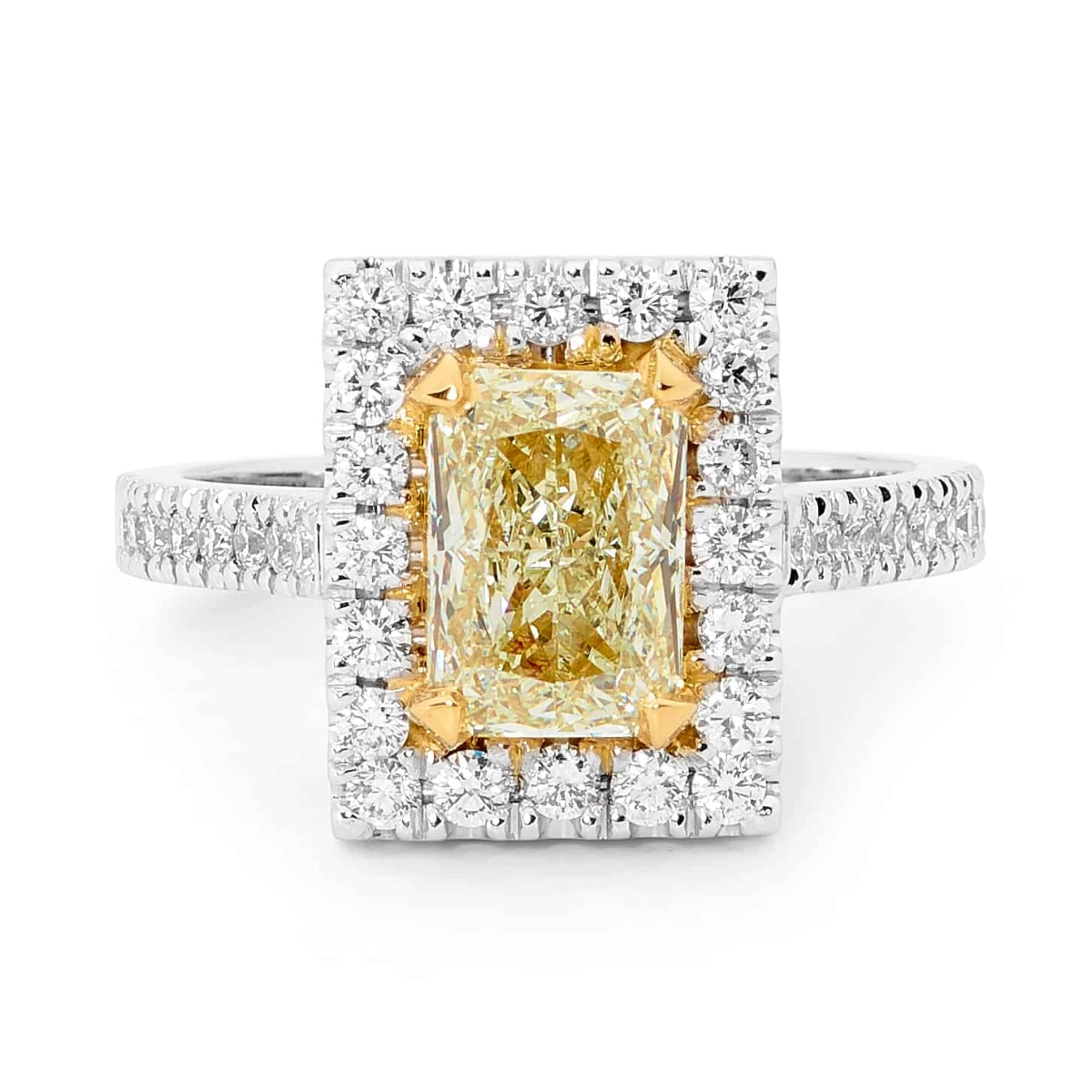
The radiant cut is the youngest shape most jewellers keep in the safe, and it solves a complaint people had been making for a century. Trimmed corners, a square or rectangular outline, and faceting that borrows the fire of a round brilliant and the architecture of an emerald cut.
At our Mt Hawthorn workshop, radiant engagement rings come up most with couples who want geometry without giving up sparkle. This guide covers how the shape works, how it differs from the cuts either side of it, and how we set it.
The History And Design Of The Radiant Cut
Henry Grossbard, a New York cutter, developed the radiant in 1977 after years of frustration that rectangular diamonds looked flat beside round ones. His answer was a mixed cut: step facets on the crown, brilliant faceting on the pavilion, roughly 70 facets in total arranged as triangles and kites. The corners are cropped rather than pointed, which is structural as much as aesthetic. Pointed corners are where diamonds chip.
It found its audience in the 1980s and has aged better than most things that did.
Square Versus Elongated Radiant Cuts
Two proportions, and the choice matters more than most buyers realise.
The square radiant runs a length-to-width ratio of about 1.00 to 1.05. It sits compactly and reads as deliberate. The elongated radiant runs 1.20 to 1.50, stretching toward a rectangle and lengthening the line of the finger the way an oval does.
Slender fingers usually suit the elongated ratios. Broader hands carry the square profile better across the knuckle. We measure the hand alongside any radiant we are considering, because the ratio has to flatter the person rather than the certificate.
Light Performance And Intense Sparkle
Those 70 facets scatter light across the whole face of the stone rather than concentrating it centrally. The trade calls it crushed ice: dense, restless, quite unlike the broad flashes of an emerald cut.
A well cut radiant reads about as bright as a round brilliant. Look for a table of 61 to 69 per cent and a depth of 61 to 67 per cent, where light enters and returns cleanly rather than leaking out the bottom. The busy pattern also hides inclusions a step cut would put on display, which affects what you pay.
Choosing Colour And Clarity For A Radiant
Radiants forgive grades an emerald cut would not, though they hold colour more visibly than a round.
For white gold and platinum, G to I colour is the practical range. Drop to J for yellow or rose gold, where warmth in the stone works with the metal rather than against it. On clarity, SI1 to VS2 is where most of our clients land, moving to VS1 above 2 carats where anything in the table is harder to ignore.
Buy the certificate as well as the stone. GIA or AGS grading gives you an assessment nobody in the transaction paid for, and our 4Cs guide covers how the grades interact. Radiants work in both natural and lab grown diamonds, and a lab grown radiant buys noticeably more carat weight at the same budget.
Setting And Metal Choices
Cropped corners open up settings a princess cut cannot safely take.
Four corner prongs cover the cropped corners while leaving the stone open to light. Halo designs, including intricate halo work with milgrain detail, frame the rectangle and push up face-up size. Three stone designs with tapered baguettes or small rounds give it a classical footing. A solitaire on a knife-edge band does nothing except point at the diamond, which is sometimes exactly right.
Yellow and white gold both flatter a radiant. Rose gold softens the elongated ratios. Platinum keeps the geometry sharp. No wrong precious metal here, only ones that say different things.
Radiant Cut Versus Emerald And Princess Cuts
The radiant occupies the gap between the two.
An emerald cut gives you clean step faceting and a quieter, glassier return, closer to looking into water than at a spotlight. A princess cut gives you a square outline with sharp corners and crisp brilliance, and those corners are its weak point. The radiant takes the emerald’s rectangle, the round’s brilliance and corners that survive a car door.
If you love the emerald outline but keep wishing it did more under light, the radiant is almost always the answer. Weighing sharper geometry instead? Our princess versus round brilliant comparison covers that.
A Recent Belmont Commission
A couple from Belmont arrived certain of two things: they wanted a long rectangle, and they hated pointed corners.
We put two stones on the tray at the same price. A 1.6 carat lab grown radiant, F colour, VS1. A 1.4 carat natural emerald cut, G colour, VS2. She studied both under the bench lamp for a long while, then carried them to the window on Scarborough Beach Road in the late afternoon, which is where most decisions in this workshop actually get made. Perth light is unforgiving and it settled the question in seconds. The radiant threw fire the emerald could not match, and the elongated ratio suited her fingers.
We built an 18 carat ring in yellow and white gold, yellow band, white corner prongs, hand-set accents down the shoulders and an engraving inside the shank only the two of them know about. Eight weeks on the bench. He proposed at Belmont Park during a Saturday meeting with the sun low over the track, and she sent us a photograph that night. It is still on the wall.
Frequently Asked Questions
The four we answer most often about this shape.
Are Radiant Cuts Less Sparkly Than Round Brilliants?
No. The 70-facet pattern returns light at a comparable level. The shape is rectangular, the brilliance is not far behind.
Are Radiant Cuts Cheaper Than Round Brilliants?
Usually. At matched colour, clarity and carat, expect roughly 20 to 30 per cent less, because the rectangular outline wastes less of the rough crystal in cutting.
Is A Radiant Cut More Durable Than A Princess Cut?
Yes. Cropped corners are far less vulnerable than the sharp points of a princess cut, which are the first thing to chip on a ring worn daily.
Can A Radiant Cut Be Set In Yellow Gold Or Rose Gold?
Absolutely. Yellow gold suits the warmth a radiant carries and rose gold pairs well with elongated ratios. White gold and platinum keep it modern.
Compare A Radiant Cut At Our Workshop
Radiants photograph well and reveal almost nothing on a screen. Those 70 facets need real light before they do anything interesting, which is why we keep loose radiants in both proportions on the premises rather than ordering them in after you have committed.
Come to Mt Hawthorn, put them side by side on your own hand and take them to the window. We will talk ratios, grades and settings once you know which one you keep looking at. Browse the custom gallery first, or start shaping something with our bespoke ring builder.
Book a consultation and we will have both proportions waiting.

Stelios Palioudakis, founder of Stelios Jewellers, has been crafting bespoke pieces since 2007. Recognised early as a finalist in the Australian Jewellery Awards, Stelios has built a brand renowned for exceptional design, quality, and loyal clientele.



Social Media