
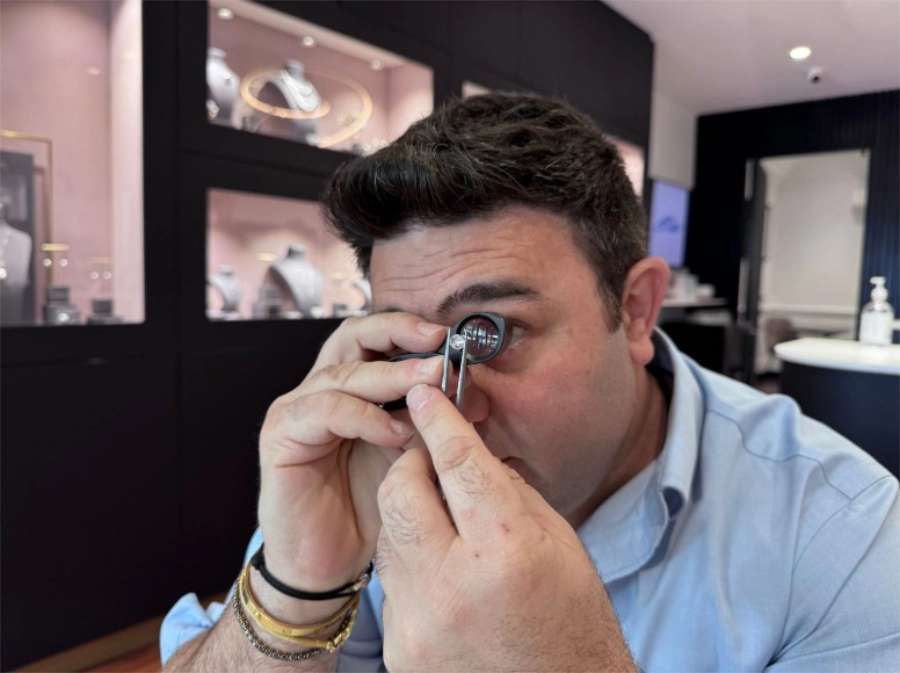
The 4 Cs of diamonds (cut, colour, clarity and carat weight) are the framework the gemmological institute developed for grading every diamond that passes through the trade. Understanding them is the difference between buying a diamond that performs on the finger and buying one that disappoints you the moment it leaves the showroom. After almost two decades grading, setting and polishing stones at our Mt Hawthorn workshop, we have a strong view on which of the 4 Cs deserve more of your budget and which can quietly slide a grade or two without anyone noticing.
This diamond buying guide walks through what each of the 4 Cs actually means, where to spend and where to save, and how to read a certified diamond report when the time comes.
Carat Weight
Carat weight is a measure of a diamond’s weight, not its size. One carat equals 0.2 grams. Two diamonds at the same carat weight can read very differently on the finger depending on their shape and cut. Round diamonds tend to read smaller than oval cuts of the same weight because the elongated shape spreads the stone across more of the finger. A one carat oval reads about the same as a 1.1 to 1.2 carat round.
Carat weight also drives diamond price more sharply than any other factor. A two carat stone costs significantly more than two one carat stones of the same colour and clarity, because larger diamonds are exponentially rarer in the rough. The price jumps at psychologically important weights (one carat, two carats, three carats), which is why we sometimes recommend stones just under the round number, where the visible difference is negligible but the saving is substantial.
Cut
Cut is the only one of the 4 Cs that depends entirely on human craftsmanship. Carat, colour and clarity are inherent to the rough crystal. Cut is created at the wheel by a skilled craftsman who decides how to facet the stone for maximum light return.
A well cut diamond reflects light back through the table in a way that produces exceptional sparkle and unparalleled brilliance. A poorly cut stone leaks light through the pavilion, which is why a poorly cut diamond can appear flat even when its other grades are excellent. Cut grades run from Excellent to Poor on the GIA scale. For round brilliant diamonds we recommend Excellent as the standard, with Very Good acceptable when budget pressure makes it sensible. For fancy shapes (oval, pear, marquise, princess, cushion, emerald) cut grade is reported through polish and symmetry, and we assess the stone in person at the bench.
If your budget forces a trade between cut and another C, never trade away cut. A perfectly proportioned VS2 stone with an Excellent cut will outperform a flawless stone with a fair cut nine times out of ten.
Colour
Diamond colour grades the absence of yellow or brown tint in a white diamond. The GIA colour scale runs from D (completely colourless) to Z (light yellow or brown). D, E and F are colourless diamonds, the rarest and most expensive grades. G, H, I and J are near-colourless and read white in most settings to most viewers. K and below carry a visible warmth.
For most engagement rings, somewhere between G and I sits in the sweet spot. A G colour diamond in white gold or platinum reads bright white. The same diamond in yellow gold can sit at I or J and still read clean because the warm metal absorbs any faint tint. Lab grown diamonds typically grade in the colourless to near-colourless range and often read whiter than natural diamonds at a similar price point.
Fancy coloured diamonds (yellow, pink, blue, green) sit on a separate grading scale entirely, where intensity of colour drives the price. A vivid fancy yellow diamond is one of the most coveted gemstones in the trade, and the rarest Australian pink diamonds command the highest prices per carat of any white or coloured stone in the world market.
Clarity
Clarity grades the presence of internal inclusions and surface blemishes visible under 10x magnification. The clarity scale runs from Flawless and Internally Flawless at the top, through VVS1, VVS2, VS1, VS2, SI1, SI2 down to I1, I2 and I3. Most diamonds we set sit between VS1 and SI1, where inclusions are not visible to the naked eye and the price is reasonable.
Clarity is the C where most buyers can save money without affecting the diamond’s appearance. The visual difference between a VVS1 stone and an SI1 stone of the same colour and cut is almost always invisible across a table to the untrained eye. The exception is step cut diamonds (emerald, asscher), where the long parallel facets reveal inclusions more readily; these benefit from VS1 or higher.
Inclusion location matters too. A small inclusion under a prong is invisible. The same inclusion under the table is harder to ignore. We always look at the plot diagram on the certificate before pricing a stone, because two SI1 diamonds can read very differently depending on where their inclusions sit.
Reading A Diamond Grading Report
Every diamond we sell comes with an independent laboratory report, almost always from GIA, IGI or AGS for white diamonds. The report covers the 4 Cs in detail: cut grade, polish, symmetry, fluorescence under ultraviolet light, colour grade, clarity grade with plotted inclusions, carat weight, and physical measurements.
The report is what allows you to compare diamonds from different jewellers honestly. Two stones at the same headline grade can still differ in performance because of fluorescence, table proportions, depth percentage and crown angle, all of which sit in the report’s detail. We walk every client through the relevant sections of the certificate before any purchase, because diamond buying without reading the report is buying blind.
Balancing The 4 Cs On A Budget
Most clients walk in with a budget rather than a perfect diamond in mind. The most useful starting point is to fix cut at Excellent or Very Good, then negotiate between the other three Cs to fit the budget. Slightly lower colour with the right metal often delivers more visible value than slightly higher clarity. Slightly under the round carat weight (a 0.95 carat instead of a 1.0 carat) can free up budget for a better cut or a better colour. Personal preference plays a role: some clients want size on the finger above all else, others want maximum sparkle in a smaller stone.
Our role is to lay out the trade-offs honestly. We can usually show two or three diamonds at the same price point that differ across the 4 Cs, so the buyer can see in person what their budget actually buys.
Natural Versus Lab Grown In The 4 Cs
Both natural diamonds and lab grown diamonds are graded on the same 4 Cs scale, by the same laboratories, using the same equipment. A lab grown diamond at G, VS1, Excellent cut, one carat is the same chemical and visual stone as a natural diamond at the same grades. The difference lies in origin and price.
Lab diamonds typically sit at a fraction of the price of comparable natural diamonds, which means a budget that buys a 0.7 carat natural diamond will often buy a 1.5 to 2 carat lab grown diamond at the same colour and clarity. For some buyers that is the right answer. For others, the long-term value and rarity of a natural diamond matter more. Both stones perform identically in everyday wear, and both belong in fine jewellery in their own right.
Frequently Asked Questions
A few of the 4 Cs questions we are asked most often.
Which Of The 4 Cs Matters Most?
Cut. A poorly cut stone leaks light regardless of how excellent its colour and clarity are. We recommend never trading cut quality for the other Cs.
What Is The Best Combination Of The 4 Cs For An Engagement Ring?
For a round brilliant, somewhere between G to I colour, VS1 to SI1 clarity, Excellent cut, and a carat weight that fits the budget. For step cut shapes, push clarity up to VS1 or higher.
Do Lab Grown Diamonds Use The Same 4 Cs Grading?
Yes. Lab diamonds are graded on identical scales by the same laboratories used for natural diamonds. The 4 Cs translate directly between the two.
How Much Does Fluorescence Affect A Diamond?
Strong blue fluorescence under ultraviolet light can sometimes give a diamond a faintly hazy appearance in daylight. Faint to medium fluorescence rarely affects visual appeal and can sometimes make a lower colour grade read whiter. We assess fluorescence on a stone-by-stone basis at the bench.
Can I Trust Online Diamond Grades Without Seeing The Stone?
The certificate is reliable for what it reports, but two stones with identical certificates can perform differently because of factors not captured numerically. Whenever possible we recommend comparing diamonds in person before committing.
Walk Through The 4 Cs At Our Bench
The 4 Cs are easier to understand with stones in your hand than from any guide on a screen. Each grade reveals itself differently under proper lighting, and the trade-offs between them only make sense when you have two or three options sitting in front of you. We run buying sessions at our Mt Hawthorn workshop specifically for this purpose, with loose certified diamond stones across the grades we expect to fit your brief.
If you are ready to begin, we welcome you in for a focused diamond buying session. Bring a sense of your budget, the diamond shape you are leaning toward, and the metal you have in mind. We will pull a small selection of stones, walk through each certificate, and help you make the call with confidence rather than guesswork. Request A Diamond Buying Session, or browse our extensive collection of Diamond Engagement Rings to see how the 4 Cs translate into finished pieces.

Stelios Palioudakis, founder of Stelios Jewellers, has been crafting bespoke pieces since 2007. Recognised early as a finalist in the Australian Jewellery Awards, Stelios has built a brand renowned for exceptional design, quality, and loyal clientele.



Social Media