
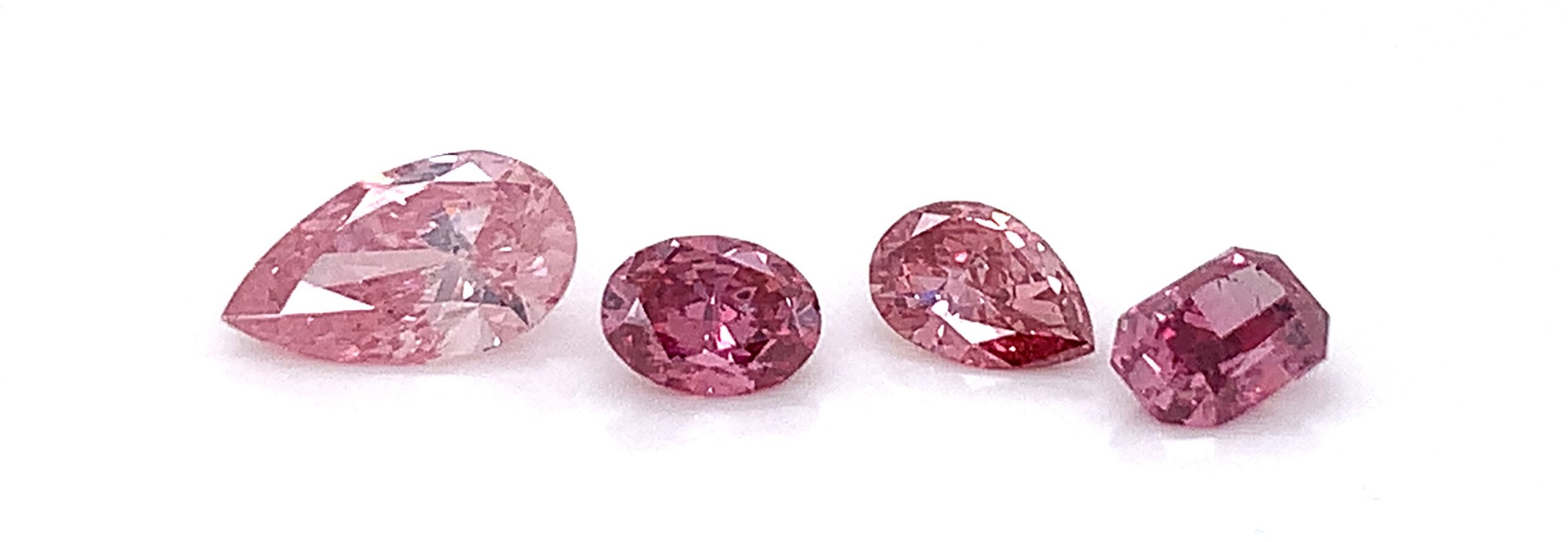
Pink diamonds sit among the most exquisite gemstones in the world, and the lab grown alternative has changed the conversation over the past decade. The central question now is whether a lab grown pink diamond is a genuine alternative to a natural one, or a different product altogether. The answer depends on what you want from the stone.
This article walks through the differences between lab grown and natural pink diamonds: how they compare in appearance, what each costs, how each holds its value over time, and which one suits different buyers. We have worked with natural Australian pink diamonds at our Mt Hawthorn studio since Stelios Palioudakis opened the studio in 2007, and while we do supply lab grown pinks for fine jewellery commissions ourselves, we talk clients through the choice regularly.
The short version: both are chemically identical diamonds. The differences are in provenance, price, rarity, and long-term value. Those differences matter more to some buyers than others, and there is a legitimate case for either option depending on what you are buying for.
What Is A Lab Grown Pink Diamond?
A lab grown pink diamond is a real diamond produced in a laboratory using advanced technology that mimics the geological conditions under which natural diamonds form. Two main growth processes create them: High Pressure High Temperature (HPHT) and Chemical Vapour Deposition (CVD). Both produce carbon crystals with the same chemical composition and physical properties as natural diamonds.
The pink colour in a lab grown pink diamond is not usually produced during growth. Most lab grown pinks are grown as white or near-colourless diamonds, then treated afterwards with post-growth irradiation or HPHT colour enhancement to shift the stone into the pink range. A small number are now produced with pink colour forming during growth through trace elements introduced into the reactor, but these remain rare and more expensive than treated equivalents.
The growth process takes weeks rather than billions of years. A one carat lab grown pink can be produced in under a month in a controlled environment using modern technology that sits on a workbench in a laboratory. This makes supply effectively unlimited, since production capacity can be expanded by adding more growth reactors.
Lab grown pinks typically carry certification from laboratories such as the International Gemological Institute (IGI) or GIA, noting both the lab grown origin and any colour treatment history.
What Is A Natural Pink Diamond?
A natural pink diamond is a diamond that formed in the earth billions of years ago and emerged with its pink colour already set by geology. The colour of a natural pink comes from a physical process called plastic deformation, where the carbon lattice is bent by the pressure of formation. No treatment is involved. The stone’s colour is part of its original structure.
Most of the natural pink diamonds in circulation today came from a single mine in the East Kimberley region of Western Australia that closed in November 2020. Smaller quantities have come from Russia, Brazil, Canada, and India, but none at comparable scale or colour quality. With the Kimberley mine closed, the supply of natural pinks is now fixed. What exists today is what will exist tomorrow.
Natural pink diamonds carry a specific place in the jewellery world. They are the original category, the benchmark for pink diamond pricing, and the stones that have made auction history at Sotheby’s and Christie’s over the past two decades.
How They Differ Head-To-Head
Lab grown and natural pink diamonds are identical on a chemistry spreadsheet. They are different stones in almost every other way that matters for a buyer.
Physical properties. Both are pure carbon arranged in the diamond crystal lattice. Both register 10 on the Mohs hardness scale. Both refract light in the same way and produce the same fire and sparkle when well cut. A gemologist needs specialist equipment to tell a well-grown lab pink from a natural pink; the naked eye cannot.
Origin. Natural pinks were born in the earth billions of years ago under conditions that cannot be reproduced elsewhere. Lab grown pinks are created in a controlled environment using modern technology, usually within a few weeks.
Supply. Natural pinks are a finite, closed category. Lab grown pinks can be produced in any quantity the market demands.
Price. Lab grown pinks typically cost 60 to 80 percent less per carat than comparable natural pinks at similar colour and clarity. A 1.0 carat Fancy Pink natural diamond that sits at $60,000 at our bench might have a lab grown equivalent priced around $12,000 to $20,000.
Value over time. Natural pinks have historically appreciated at 8 to 15 percent annually at the top colour grades. Lab grown pinks have been softening in price as production capacity expands. A lab grown pink bought today is likely to be worth less in 15 years than it cost, not more.
Rarity and provenance. A natural pink carries rarity, geological history, and often documented origin paperwork tracing it to a specific year of tender production. A lab grown pink carries modern provenance and a growth batch number. Both are legitimate, but the collecting and resale markets treat them very differently.
Appearance And Brilliance
A well-cut lab grown pink diamond produces the same brilliance, fire, and scintillation as a well-cut natural pink. Side by side under showroom lighting, most clients struggle to pick a visible difference. Both sparkle equally, and both catch light through the same facets regardless of how the stone was formed.
Subtle differences can show up under close inspection. Lab grown pinks occasionally carry internal growth patterns or fluorescence signatures distinct from natural pinks, visible only through specialist magnification. Natural pinks sometimes show microscopic inclusions (called grain lines) from the pressure deformation that gave them their colour. Neither affects how the stone looks on the hand.
The colour range is similar across both categories. Fancy Light Pink through Fancy Vivid Pink saturation grades exist in both lab grown and natural form, and the same rules apply around how shape and cut quality affect the visual reading of the colour. Purplish pink and red-pink modifiers are less commonly produced in lab grown at the moment, but the technology is evolving quickly.
For an engagement ring or pink diamond jewellery piece where the visual impact is the primary motivation, both options deliver on beauty, sparkle, and everyday wear. The choice comes down to the other factors.
Price And Value Over Time
This is where the two categories most clearly diverge.
Lab grown pink diamond prices have dropped by roughly 70 percent over the past five years as production capacity scaled. Retail prices have followed, which is good news for buyers today and difficult news for anyone who bought a lab grown pink five years ago expecting it to hold value. As more laboratories enter the market and growth reactors become more efficient, prices will likely continue to soften.
Natural pink diamonds have moved in the opposite direction. Since the Kimberley mine closed in November 2020, fixed supply has met rising demand, and appreciation at the top grades has accelerated. A natural Fancy Intense Pink bought today, at the quality level we stock, is more likely than not to appreciate in value over the next decade.
This creates two distinct value propositions:
- Lab grown pink. Maximum visual impact per dollar today. Minimal resale value later. Suitable for buyers who want the appearance without the investment dimension.
- Natural pink. Higher entry price. Appreciating asset. Suitable for buyers who want the stone to hold or grow in value over decades.
Neither is the wrong answer. They simply answer different questions.
Which Option Is Right For You
A few practical frames for the decision.
Budget is the binding constraint. If you want a pink centre stone and price is the main limit, lab grown gets you there faster. A couple with a $10,000 engagement ring budget can usually find a lab grown Fancy Pink centre stone with meaningful presence on the finger. The same budget in natural typically buys a small Fancy Light or Faint Pink stone.
Ethical considerations. Some buyers choose lab grown specifically to avoid the environmental damage associated with mining. The Kimberley operation is now closed and cannot produce further impact, but broader mining concerns still influence some buyers. Lab grown production has a smaller mining footprint by definition.
Investment or inheritance motivation. Buyers who want the stone to carry or grow value across generations should buy natural. Lab grown does not appreciate.
Wearability only. If the stone is purely for how it looks on the finger, lab grown is a reasonable choice. The sparkle is identical, and it pairs elegantly with any metal band: white gold, yellow gold, rose gold, or platinum.
Pairing with other natural jewellery. If the pink diamond will sit alongside natural diamonds in a halo, three-stone setting, or stacked band, consider matching category. Both blend visually but some collectors prefer consistency.
Who is wearing it. Many of the women we design pink diamond jewellery for want to know the stone came from the earth rather than a reactor. Others genuinely do not mind. Ask before you decide.
A Recent Conversation With A Client
A couple from North Fremantle came to us last year engaged and considering a pink diamond engagement ring. Their budget was $40,000 total, and they knew they wanted pink as the centre stone. They asked us directly about lab grown versus natural.
We walked them through both paths at their budget. A lab grown 1.1 carat Fancy Pink, set in 18ct rose gold, would cost them around $9,500 and leave roughly $3,500 for the setting, band, and future wedding band. A natural 0.20 carat Fancy Pink at similar colour would cost around $50,000, using all of their budget and leaving little room for anything else.
They chose the natural path. The reasoning was specific: the partner wearing the ring wanted to know the stone was the same kind of pink diamond her grandmother had once owned, and the lab grown option, accurate as it is chemically, did not carry the same meaning for her. We designed a simple 18ct yellow gold bezel setting around the 0.20 carat stone and delivered the ring three weeks later.
This is the pattern we see most often at the bench. Clients make the choice based on what the stone represents to them, not what it costs. Both lab grown and natural are legitimate, and the right one is the one that fits the story the buyer is trying to tell.
Frequently Asked Questions
Are Lab Grown Pink Diamonds Real Diamonds?
Yes. Lab grown pink diamonds are chemically, physically, and optically identical to natural pink diamonds. They are real diamonds grown in a laboratory rather than mined from the earth. The difference is origin, not substance.
Can A Jeweller Tell A Lab Grown Pink Diamond From A Natural One?
Only with specialist equipment. The differences sit at the microscopic level and are not visible to the naked eye. Every certified lab grown pink carries laboratory documentation confirming its origin, so there is no ambiguity at purchase if the stone is properly certified.
Do Lab Grown Pink Diamonds Hold Value?
No, not in the way natural pinks do. Lab grown pink prices have fallen sharply over the past five years and are likely to continue softening as production capacity expands. Buy lab grown for the appearance, not for resale value.
Is A Lab Grown Pink Diamond Ethical?
Lab grown production avoids the environmental damage of mining, which some buyers value highly. Natural pinks from the Kimberley source were mined under Rio Tinto’s Western Australian environmental standards, which are relatively strong by global standards. Both have ethical credentials. The choice depends on which aspect of ethics matters most to you.
How Do I Care For A Pink Diamond?
The same care applies to both lab grown and mined pink diamonds. Clean with warm water, a drop of gentle dish soap, and a soft cloth or soft toothbrush. Avoid harsh chemicals such as bleach, ammonia, and pool chlorine. Store the stone separately from other jewellery to prevent scratching. Annual professional inspection keeps the setting secure and the stone seated.
Will A Lab Grown Pink Diamond Appreciate In The Future?
Unlikely, at least for the next decade. Production capacity continues to grow and prices continue to soften. Buy lab grown for immediate wearability, not long-term appreciation.
Come And See A Natural Pink Diamond In Person
If you are weighing up the lab grown versus mined pink diamond question, the conversation is easier in person with stones in hand. Come in to our Mt Hawthorn studio and we will show you what natural pinks currently in our reserve look like at different grades and price points, talk you through the lab grown alternative honestly, and help you make the decision that fits your budget, your values, and the reason you are buying.
Book A Pink Diamond Consultation or browse our Pink Diamond Jewellery collection.

Isabelle Pontis, lead designer at Stelios Jewellers, brings 27 years of experience and a renowned eye for detail. Her bespoke designs blend technical mastery with artistic vision, shaping the signature style and quality of Stelios Jewellers.



Social Media