
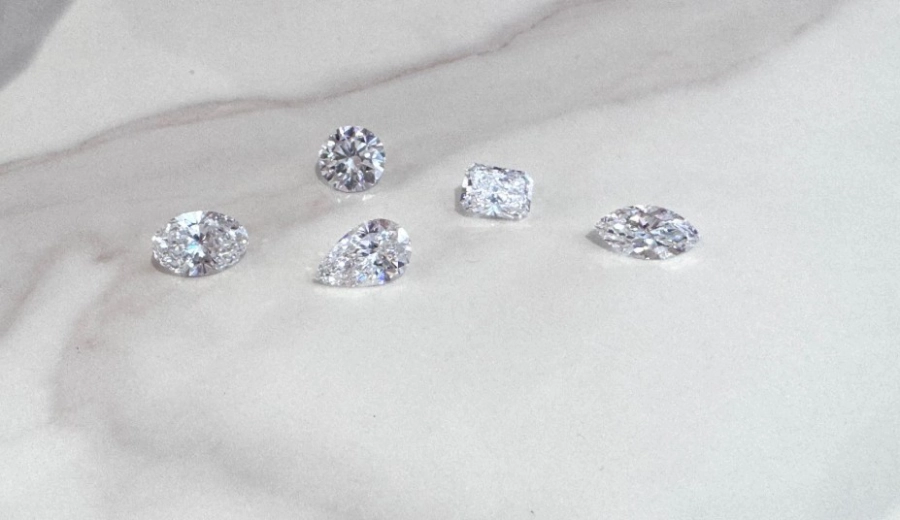
The diamond market has changed substantially over the past decade. Lab grown diamonds now make up around 20 to 25 percent of global engagement ring sales, and that share keeps growing. Both categories are real diamonds with the same physical and optical properties, but they sit in different places in the market, and the right choice for any given buyer depends on what the diamond is for.
This guide covers what lab grown diamonds are, how they compare with earth mined diamonds, what each costs, how each holds value, and how to weigh the ethical questions. We have worked with both lab grown and mined diamonds for fine jewellery commissions at our Mt Hawthorn studio since Stelios Palioudakis opened the doors in 2007.
What Are Lab Grown Diamonds?
Lab grown diamonds are real diamonds produced in a laboratory rather than mined from the earth’s crust. They are crystallised carbon with the same chemical, physical, and optical properties as natural diamonds. The Federal Trade Commission and gem industry bodies recognise them as genuine diamonds, not synthetic alternatives.
Two processes create them. High Pressure High Temperature (HPHT) uses extreme pressure and high temperature to mimic conditions deep in the earth’s crust where natural diamonds form. Chemical Vapour Deposition (CVD) grows diamond crystals layer by layer in a chamber filled with carbon rich gases that deposit on a small diamond seed. Both processes take a few weeks, compared with the millions of years natural diamonds spent forming.
Lab grown diamonds are graded the same way as mined ones. The Gemological Institute of America (GIA) and other recognised laboratories assess the same 4 Cs: cut, colour, clarity, and carat weight. Most lab grown stones today are produced as white diamonds in the colourless to near-colourless range, though coloured varieties are also created.
What Are Natural Diamonds?
Natural diamonds are mined from the earth’s crust after forming over hundreds of millions to billions of years under extreme heat and high pressure. Volcanic activity carried these stones up through kimberlite or lamproite pipes toward the earth’s surface, where they are extracted, sorted, cut, and polished for the global market.
Most natural diamonds sold in Australia today come through suppliers compliant with the Kimberley Process, an international certification scheme designed to prevent the trade in conflict diamonds (also known as blood diamonds). The Kimberley Process is not perfect, but it covers around 99 percent of the world’s rough diamond production.
Natural diamonds carry geological history that lab grown stones cannot replicate. Each is a unique product of the earth, with tiny amounts of trace elements and microscopic growth patterns that record the conditions under which it formed.
How Lab Grown And Natural Diamonds Compare
The two categories are identical in chemistry but different in nearly every other dimension that matters to a buyer.
Physical and optical properties. Identical. Both are pure carbon arranged in the diamond crystal lattice. Both register 10 on the Mohs hardness scale. Both refract light the same way and produce the same fire and brilliance when well cut. The naked eye cannot tell them apart.
Origin. Natural diamonds formed in the earth over geological timescales. Lab grown diamonds are man made diamonds produced in weeks using HPHT or CVD technology.
Supply. Mining natural diamonds is constrained by what is in the ground. Lab grown supply expands with production capacity, which is why availability has grown sharply year on year.
Clarity grades. Both can be produced or found across all clarity grades. Microscopic differences exist but are not visible in the finished stone.
Certification. Both carry independent grading from laboratories like GIA, IGI, and AGS. Always insist on certification, regardless of which side you buy.
The Price Difference
Price is the most consistent difference.
Lab grown diamonds cost 60 to 80 per cent cheaper than comparable quality natural diamonds at the same carat weight, colour, and clarity. A 1.0 carat round brilliant in G colour, VS1 clarity, with excellent cut, currently sits around $9,000 to $13,000 in natural form at our bench. The lab created equivalent of the same specs prices at $2,500 to $4,000.
The price gap has widened over the past five years as lab grown production has scaled. Wholesale lab grown prices have fallen by roughly 70 percent since 2019, and retail has followed. For buyers prioritising visual impact at a given budget, lab grown gets you a larger or higher quality stone than natural at the same price.
Resale And Investment Value
Natural diamonds have historically held their value, with high quality stones appreciating modestly over decades. Top tier coloured natural diamonds (pinks, blues) have appreciated more strongly. Resale through trade channels typically realises 30 to 50 per cent of original retail price.
Lab grown diamonds have weak resale value. Because supply continues to expand and prices continue to fall, a lab grown diamond purchased today is likely to be worth less in ten years than what you paid. Trade buy-back, where it exists, typically pays 10 to 25 per cent of retail.
If the diamond is being bought as wearable jewellery rather than a financial instrument, this may not matter. If the stone is intended as an heirloom or store of value, the difference becomes critical to the decision.
Ethics And Environmental Impact
Both categories carry ethical dimensions worth weighing.
Diamond mining has historically raised concerns around environmental impact, labour practices, and conflict diamonds. Modern mining under the Kimberley Process and stricter national regulations has improved this picture significantly, but lab grown diamonds avoid the issue by design and are often marketed as ethical alternatives.
Lab grown diamond production is itself energy-intensive. Whether the energy comes from renewable or fossil-fuel sources varies by producer. Some lab grown manufacturers run on renewable energy and market themselves accordingly. Others do not. There is no single right answer on ethics. Many buyers find personal preference plays a larger role than they expected once they sit with the choice.
A Recent Client Story
A couple from Mt Lawley came to us last year with a $7,500 engagement ring budget. They wanted a round brilliant centre stone in a classic six-claw solitaire setting, and they wanted to maximise visible size at their budget.
We showed them three options: a 0.7 carat natural stone in G colour, VS2 clarity, well cut, with GIA grading; a 0.5 carat natural stone in higher colour and clarity at the same price; and a 1.4 carat lab grown stone in G colour, VS1 clarity, also GIA graded. All three were beautiful. The lab grown stone on the hand looked dramatically larger.
They chose the 1.4 carat lab grown. Neither of them treated the ring as an investment. The wearer wanted visible size more than long-term value, and the saved budget went toward the wedding band and the honeymoon. We set the lab grown stone in 18ct white gold and delivered the ring four weeks later. The natural option might have been right for a different couple. Both choices are valid depending on what matters most to the buyer.
Frequently Asked Questions
Are Lab Grown Diamonds Real Diamonds?
Yes. The Federal Trade Commission and global gem industry bodies recognise lab grown diamonds as genuine diamonds with the same physical, chemical, and optical properties as natural diamonds. The only difference is origin.
Are Lab Grown Diamonds Good Quality?
They can be. Modern lab grown diamonds reach all the same colour and clarity grades as natural diamonds, and many lab grown stones at the top end exceed average natural quality. Always insist on independent certification regardless of category.
Can A Jeweller Tell A Lab Grown From A Natural Diamond?
Only with specialist equipment. Standard jeweller’s tools cannot reliably distinguish them. Both categories are graded and certified by laboratories that can identify origin definitively, which is why certification matters at purchase.
Are Lab Grown Diamonds The Same As Cubic Zirconia?
No. Cubic zirconia is a different material (zirconium dioxide) that imitates diamonds visually but has different physical properties and lower hardness. Lab grown diamonds are real diamonds. Cubic zirconia is a simulant.
How Much Cheaper Are Lab Grown Diamonds?
Typically 60 to 80 per cent cheaper than comparable natural diamonds at the same carat weight and quality grade. The exact gap varies by size and grade.
Will My Lab Grown Diamond Hold Its Value?
Lab grown diamonds have weak resale value relative to natural. Prices have been falling as production capacity expands, and the trend is likely to continue. Buy lab grown for the appearance rather than the investment.
Come And See Both Side By Side
The lab grown versus natural decision is easier in person, with both categories on the bench under the same lights. Come in to our Mt Hawthorn studio and we will show you stones from each side at your budget, walk you through certification, and help you make the right choice for what the diamond is actually for.

Isabelle Pontis, lead designer at Stelios Jewellers, brings 27 years of experience and a renowned eye for detail. Her bespoke designs blend technical mastery with artistic vision, shaping the signature style and quality of Stelios Jewellers.



Social Media