
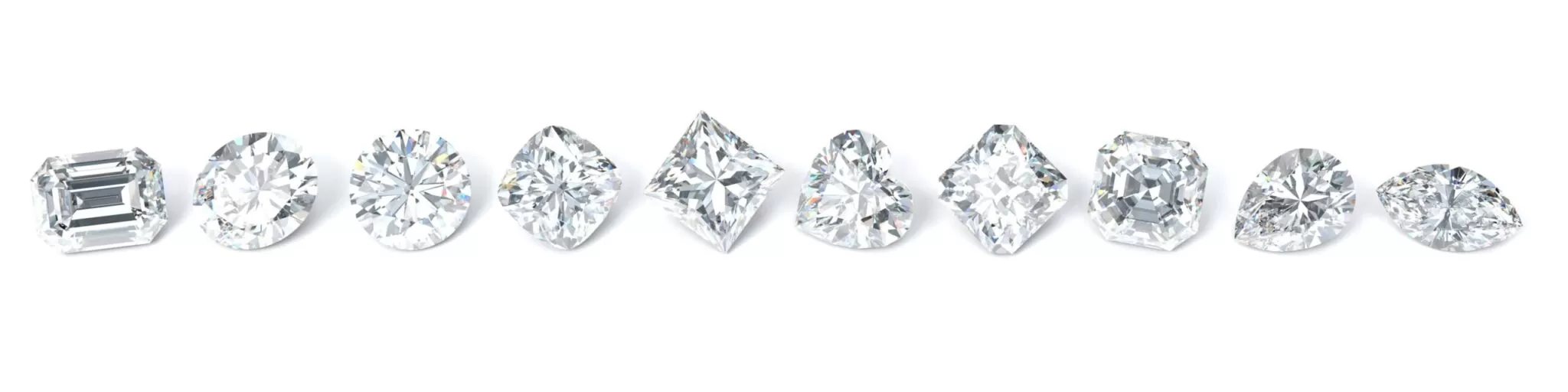
A lab grown diamond is a real diamond produced in a laboratory rather than mined from the earth. It has the same chemical, physical, and optical properties as a natural diamond, the same crystal structure, and the same hardness on the Mohs scale. The Federal Trade Commission and the global jewellery industry both recognise lab grown diamonds as genuine diamonds, not synthetic alternatives or simulants.
This article is the long version. It walks through what a lab grown diamond actually is, how the two main production methods work, what separates lab grown diamonds from cubic zirconia and other diamond simulants, how lab created diamonds are graded, where the market is heading, and where the ethical questions sit. We have worked with both lab grown and mined diamonds at our Mt Hawthorn studio since Stelios Palioudakis opened the doors in 2007, and we have watched the lab grown side of the diamond industry move from a curiosity into a meaningful share of the global market over the past two decades.
A Lab Grown Diamond Is Pure Carbon Crystallised In A Lab
A lab grown diamond is pure carbon arranged in the diamond crystal lattice, the same atomic structure that produces a natural diamond. The atoms are bonded in the same tetrahedral form. The hardness, brilliance, and thermal properties match those of a mined diamond. The only real difference is where the stone formed.
Natural diamonds form deep in the earth’s mantle, roughly 150 kilometres below the earth’s surface, over hundreds of millions to billions of years under enormous pressure and extreme heat. Volcanic activity later carries them up through kimberlite or lamproite pipes to mining depth, ready for the mined diamond industry to extract.
Lab grown diamonds form in a laboratory chamber over a few weeks, using one of two production methods that recreate the conditions of diamond formation under controlled industrial conditions. The growth process starts with a small diamond seed and builds the larger diamond around it atom by atom.
The Federal Trade Commission ruled in 2018 that lab grown diamonds meet the definition of “diamond” and removed the requirement that “synthetic” or “artificial diamonds” be used to describe them. The Gemological Institute of America (GIA) and other major laboratories now grade lab grown diamonds using the same 4 Cs system applied to mined diamonds.
The Two Main Production Methods
Almost every lab grown diamond on the market today was produced through one of two methods, both of which use cutting edge technology developed over the past several decades.
High Pressure High Temperature (HPHT)
The HPHT process recreates the conditions of natural diamond formation. A small diamond seed is placed in a chamber alongside a carbon source, usually graphite. The chamber is heated to extremely high temperatures (around 1,400 to 1,600 degrees Celsius) and subjected to high pressure (around 5 to 6 gigapascals, equivalent to 50,000 to 60,000 atmospheres of pressure).
These conditions cause the carbon to dissolve into a metallic catalyst (usually iron, nickel, or cobalt), then crystallise onto the diamond seed, growing the larger diamond layer by layer. Modern HPHT setups use belt presses or cubic presses to generate the required pressure, and a single growth run can produce several gem quality diamonds at once.
HPHT was the first commercially viable lab grown diamond technology, dating to General Electric’s research in the 1950s. The process initially produced only small industrial diamonds. By the 2000s, gem-quality HPHT diamonds reached the market, and by the late 2010s, single crystal diamond stones in the 1 to 5 carat range were routinely produced.
Chemical Vapour Deposition (CVD)
The CVD process is more recent and increasingly dominant. A diamond seed is placed in a vacuum chamber filled with carbon-rich gases, typically methane and hydrogen. The chamber is heated to around 800 to 1,200 degrees Celsius (lower than HPHT but still high temperature) and the gases are ionised into plasma using microwave or hot filament technology.
The plasma breaks the carbon-rich molecules apart, and the freed carbon atoms deposit onto the diamond seed, growing the diamond layer by layer. CVD methods produce diamond crystals in flat plate form rather than the more rounded shape produced by HPHT.
The CVD process is generally considered the more advanced and scalable of the two. CVD setups can produce larger diamond stones, more cleanly grown, with finer control over the resulting properties. The pace of improvement in CVD over the past decade has been the main driver of falling lab grown diamond prices.
How A Lab Grown Diamond Differs From Other Stones
Diamond simulants and lab grown diamonds are often confused. They are not the same.
Cubic zirconia is a synthetic crystal made from zirconium dioxide. It looks like a diamond to the naked eye but has different chemical properties, lower hardness (around 8 to 8.5 on the Mohs scale versus 10 for diamond), and significantly less brilliance and fire. Cubic zirconia is a simulant, not a real diamond.
Moissanite is silicon carbide, another simulant. It is harder than cubic zirconia (around 9.25 on the Mohs scale) and brighter than a diamond, but the optical properties differ and a trained eye can usually tell. Moissanite is also a simulant.
Lab grown diamond is a real diamond. The chemical composition is pure carbon (C), the same material as a mined diamond, with the same crystal structure and the same characteristics. The only real difference between a lab grown stone and a natural one is where the carbon crystallised.
This distinction matters legally, technically, and commercially. The Federal Trade Commission and gem industry bodies are clear: lab grown diamonds are real diamonds. Cubic zirconia, moissanite, and other diamond simulants are not.
The Physical, Chemical, And Optical Properties
A lab grown diamond is chemically identical, physically identical, and optically identical to a natural diamond. This is not a marketing claim. It is a measurable fact verified by every major gem laboratory.
Chemical properties. Both lab grown and mined diamonds are pure carbon arranged in the diamond cubic crystal structure. Trace elements may differ slightly (lab grown stones sometimes carry trace nitrogen or boron differently from their natural counterparts), but the bulk composition is identical.
Physical properties. Both register 10 on the Mohs scale of hardness, the highest possible rating. Both have the same density, the same refractive index (2.42), and the same dispersion (the property that produces the diamond’s signature fire). Both have the same high thermal conductivity, which is one of the tests gemologists use to distinguish diamonds from simulants.
Optical properties. Both produce the same brilliance, fire, and scintillation when well cut. Two stones cut to the same proportions, one lab grown and one earth created, will look identical to the naked eye and under most magnification. Specialist equipment can sometimes detect subtle growth pattern differences, but these are not visible in the finished stone.
The visual sameness is what allows lab grown stones to function as direct substitutes in fine jewellery. A lab grown diamond ring will sparkle, refract light, and resist scratches the same way a mined counterpart will.
How Lab Grown Diamonds Are Graded
Major gem laboratories grade lab grown diamonds using the same standards applied to mined diamonds. The Gemological Institute of America (GIA), the International Gemological Institute (IGI), and the American Gem Society (AGS) all issue grading reports for lab grown stones.
The grading covers the standard 4 Cs:
Cut. How well the stone has been faceted, with grades ranging from Excellent to Poor. Cut quality determines how light reflects and refracts through the stone, and is the single largest visual factor in a finished diamond.
Colour. The colour scale runs from D (colourless) through Z (noticeably yellow) for white diamonds. Most lab grown stones are produced as colourless diamonds in the colourless to near-colourless range. Yellow diamonds, blue diamonds, and other coloured varieties are also produced through trace element introduction.
Clarity. The clarity scale runs from Flawless (FL) through Included (I), measuring internal inclusions and surface blemishes. Lab grown diamonds reach the highest clarity grades regularly.
Carat weight. Both lab grown and mined diamonds are weighed and priced by carat. The metric is identical across both categories.
A grading report for a lab grown diamond will explicitly note its origin (typically “Laboratory-Grown Diamond”) and the production method where determinable. This labelling distinguishes the stone from natural diamonds at the certificate level. Reputable jewellers always disclose lab grown origin at the point of sale; this is required by Federal Trade Commission rules and equivalent regulations in most major markets.
The Lab Grown Diamond Market
Lab grown diamonds have moved from a niche category into a meaningful share of the global diamond market over the past decade. Industry estimates put lab grown sales at around 20 to 25 percent of new engagement ring purchases globally, and the share is rising every year. Lab grown diamond jewellery now occupies dedicated sections in most major retailers.
Wholesale prices for lab grown diamonds have fallen by roughly 70 to 80 percent since 2019, driven by expanded production capacity and improved CVD process efficiency. Retail prices have followed. A 1 carat lab grown round brilliant that cost around $5,000 to $7,000 in 2019 sits closer to $1,500 to $2,500 today at comparable quality.
This price trajectory has changed buyer behaviour. Couples who would once have bought a 0.5 carat natural diamond can now afford a 1.0 to 1.5 carat lab grown stone at the same budget, with similar visual quality. The opportunity to save money without compromising on appearance is the main reason lab grown stones have grown the way they have.
Resale Value And Long-Term Considerations
Lab grown diamonds have weak resale value compared to natural diamonds. Because production capacity continues to expand and prices continue to fall, a lab grown diamond bought today is likely to be worth less in five to ten years than what you paid. Trade buy-back, where it exists, typically pays 10 to 25 percent of original retail.
Natural diamonds, by contrast, have historically held value, with high-quality stones appreciating modestly over decades. Top-grade naturals (particularly coloured varieties) have appreciated more strongly. Natural diamond resale through trade channels typically realises 30 to 50 percent of original retail.
The implication is straightforward: a lab grown diamond is a better choice if the buyer values appearance and budget over long-term value. A mined diamond is a better choice if the stone is intended as an heirloom, store of value, or eventual resale asset. Both categories are legitimate. The right choice depends on the buyer’s priorities.
Ethics And Environmental Picture
Lab grown diamonds are often marketed as ethical alternatives to mined diamonds. The picture is more nuanced than the marketing suggests.
Conflict diamonds. Mined diamonds historically raised concerns around blood diamonds and conflict diamonds, particularly from certain African mining regions during the 1990s and early 2000s. The Kimberley Process, established in 2003, now covers around 99 percent of global rough diamond production and is designed to prevent conflict diamonds entering the legitimate trade. Lab grown diamonds avoid this concern by design.
Environmental impact. Diamond mining has a substantial environmental footprint, including land disturbance, water use, and emissions. Lab grown production has its own footprint, primarily through the energy consumption of HPHT and CVD reactors. Whether the lab grown footprint is smaller depends on the energy source. Producers running on renewable energy genuinely reduce environmental impact. Producers running on fossil fuels often produce comparable emissions to a modern mining operation per carat.
Provenance. Mined diamonds can carry chain-of-custody documentation tracing the stone to a specific mine. Lab grown diamonds carry growth batch numbers but no geological provenance. For some buyers this is meaningful; for others it is not.
Ethical sourcing is a real concern in either category. The right answer depends on which aspect of ethics matters most to the individual buyer.
A Recent Client Conversation
A couple from Inglewood came in last year with technical questions rather than the usual style and budget conversation. He works as a chemical engineer at a Perth refinery, and she is a software developer. Both wanted to understand the process before making a decision.
We walked them through both the HPHT and CVD methods, the actual chemistry of diamond formation under each process, and the certification differences between lab grown and mined diamonds. They were particularly interested in the trace element profiles that distinguish lab grown stones from their natural counterparts at the spectroscopic level, even if not visible to the naked eye.
They chose a 1.6 carat CVD-grown round brilliant in F colour, VS1 clarity, with GIA certification, set in 18ct white gold (a precious metal that suits a colourless diamond well) for a classic six-claw solitaire. The stone cost approximately $5,200, considerably less than the comparable natural stone they had been quoted elsewhere, which sat around $21,000. They were satisfied that the science was sound, and the saved budget went toward a deposit on their first home.
They told us afterwards that the technical depth of the conversation tipped the decision. The science of lab grown diamonds is genuinely interesting once you sit with it, and the quality of the finished stone is real.
Frequently Asked Questions
Are Lab Grown Diamonds Real Diamonds?
Yes. The Federal Trade Commission and global gem industry bodies recognise lab grown diamonds as genuine diamonds. They have the same chemical composition (pure carbon), same crystal structure, same physical properties, and same optical properties as natural diamonds. The only real difference is where the stone formed.
Are Lab Grown Diamonds The Same As Cubic Zirconia?
No. Cubic zirconia is a different material that imitates the appearance of a diamond but is significantly softer, less brilliant, and chemically distinct. Cubic zirconia and other diamond simulants are not real diamonds. Lab grown diamonds are.
How Are Lab Grown Diamonds Made?
Two main methods. High Pressure High Temperature (HPHT) recreates the conditions of natural diamond formation in a chamber under enormous pressure and high temperature, often using belt presses to generate the load. Chemical Vapour Deposition (CVD) grows diamond crystals layer by layer in a vacuum chamber filled with carbon-rich gases. Both processes start from a small diamond seed and produce gem-quality stones over a few weeks.
Can A Jeweller Tell A Lab Grown From A Natural Diamond?
Only with specialist equipment. Both stones look identical to the naked eye and under standard jeweller’s magnification. Spectroscopic equipment can identify origin reliably, which is why every reputable lab grown diamond carries explicit certification of its origin.
Do Lab Grown Diamonds Hold Their Value?
Not as well as natural diamonds. Lab grown prices have fallen sharply as production capacity expanded, and the trend is likely to continue. Natural diamonds historically appreciate or hold their value modestly. Buy lab grown for appearance and to save money; buy natural for long-term value.
Are Lab Grown Diamonds More Ethical Than Mined Diamonds?
It depends on what aspect of ethics matters most. Lab grown avoids mining-related environmental and labour concerns by design but has its own energy footprint. Mining under the Kimberley Process and modern regulations has improved significantly. Both have ethical credentials. Both have ethical compromises.
What Sizes And Colours Are Available?
Most common sizes from below 0.25 carat through 5 carats and beyond, with current technology able to produce single crystal diamonds at ten carats and above. Colourless, near-colourless, yellow, pink (treated), and blue varieties are produced. The full range of fancy colours is now commercially available.
Will A Lab Grown Diamond Last A Lifetime?
Yes. Lab grown diamonds have the same hardness as natural diamonds (10 on the Mohs scale) and the same wear characteristics. With normal care, a lab grown diamond will last as long as a natural one, which is effectively forever.
Come And See A Lab Grown Diamond In Person
If you want to see what lab grown diamonds actually look like in person, come in to our Mt Hawthorn studio. We will show you stones in different sizes and grades, explain the certification, and talk you through how the choice fits your priorities. Whether you end up choosing lab grown or mined, the conversation in person is more useful than any article.

Andy McGee, Manager and Master Jeweller at Stelios Jewellers, brings over 38 years of experience from London and Perth. Known for his precision craftsmanship and eye for detail, he oversees the creation of bespoke pieces to the highest standards. A career highlight includes leading the production of the Miss Universe crowns, and he continues to craft standout designs for prestigious jewellery competitions.



Social Media