
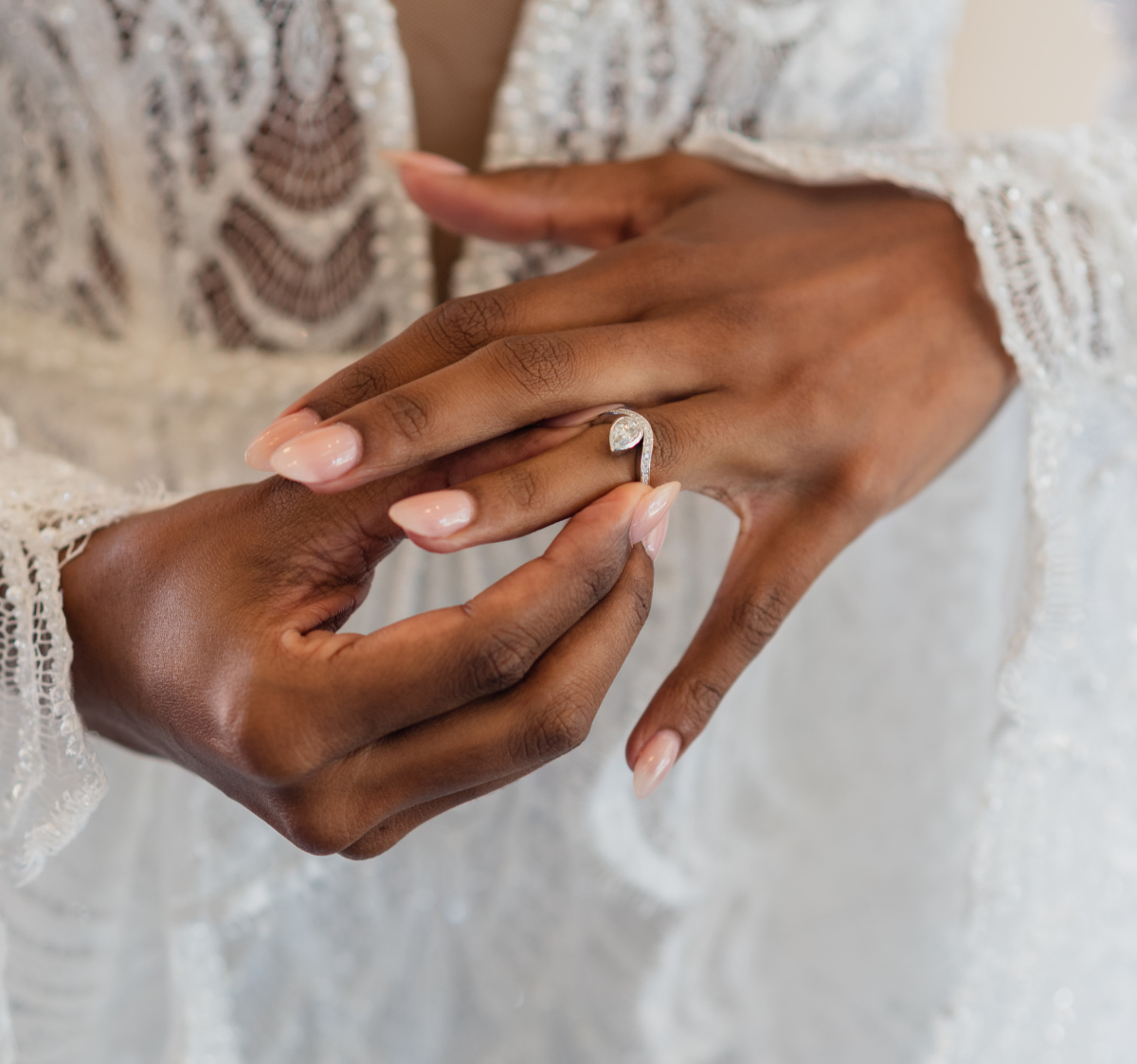
In Australia the wedding ring goes on the fourth finger of the left hand. That is the hand it is placed on during the ceremony and, for most people, the hand it stays on for the next fifty years. There are good reasons to do otherwise.
This guide is for anyone newly engaged, or from a family where the left is not the automatic answer. It covers where the convention came from, which countries differ, how to choose if you work with your hands, and how to look after a daily band. If the finger rather than the hand is your question, start with our wedding ring finger guide.
Master jeweller Stelios Palioudakis has run our Mt Hawthorn studio since 2007, and the bench behind him carries close to two centuries of combined experience. The same hands that made the 2020 Miss Universe Australia crown and the West Australian Symphony Orchestra brooches make the wedding bands leaving here every week. These are the questions that reach us most often, usually from someone holding a ring box and looking slightly worried.
The Short Answer: Left Hand, Fourth Finger
Left hand, fourth finger, counting from the thumb. During the ceremony the band goes on first, closest to the knuckle, with the engagement ring returned above it afterwards, so the vows sit nearest the heart. Plenty of brides shift the engagement ring across for the ceremony and swap it back over the champagne. For the stacking question, see which order you wear engagement, wedding and eternity rings.
Why The Left Hand Became Standard
Two reasons, one poetic and one entirely practical.
The poetic one is Roman. Ancient Romans believed a vein ran from the fourth finger of the left hand straight to the heart, the vena amoris. The anatomy is wrong, which every jeweller knows and nobody mentions at a wedding. The image was too good to lose, and it outlived the Romans by two thousand years, carried through European practice into the Commonwealth and out here with English-speaking settlers.
The practical reason has more staying power. Most people are right-handed, so the left hand does less work, and a band there gets knocked less and thins more slowly. Rings arriving for retipping around the ten year mark are visibly thinner underneath if they have lived on a dominant hand. For left-handers, of course, the convention puts the ring on the busy hand.
Cultures Where The Right Hand Is Worn
The left hand is a Western habit, not a universal one, and in a city as mixed as Perth that matters more than most guides admit.
Russia, Greece, Poland, Ukraine and Serbia wear the band on the right, because Orthodox tradition puts oaths and blessings in that hand. Germany, Austria and the Netherlands often move it across after the ceremony. Spain, Colombia and much of South America favour the right, and in India right-hand wear has deep roots, though younger couples increasingly follow Western practice.
This one is close to home. Stelios is Greek, and plenty of couples through our door are negotiating exactly this. One partner from an Orthodox family expecting the right hand, the other assuming the left because that is what every Australian wedding they have attended looked like. It reliably becomes a conversation with the parents. Reconciling old custom with something a modern couple actually wants to wear is more or less our house speciality, and it is why we make Greek jewellery alongside everything else.
There is no correct resolution. Some couples take one hand each. Some go right for the ceremony and left afterwards. Nobody regrets choosing on the basis of what their family means to them.
Dominant Hand Or Non-Dominant?
Once tradition is settled, a practical decision sits underneath it.
The non-dominant hand, the left for most Australians, is kinder to the ring. Less abrasion, fewer collisions with doorframes and gym bars, simpler to slide off before gloves. The dominant hand has arguments too. You see the ring all day, it stays put if the other hand ends up in a cast, and tradition may point that way.
Where we will give an opinion: if your dominant hand does heavy work, put the ring on the other one. Trades, nursing, surgeons, professional sport, anyone playing an instrument for a living. Tradition is a poor reason to reshape a band every three years. We can always make a plain, low-profile wedder for the working hand and keep the good one for weekends.
If you genuinely cannot decide, there is a practical way through it. Every bespoke piece we make goes from 3D rendering to a silver prototype before anything is cast, and clients interstate get theirs posted out. Wear the prototype on both hands for a fortnight. You will know by the end of the first week which one feels like yours, and nothing has been committed to gold yet.
Wearing Both Rings On The Same Hand
For anyone wearing an engagement ring and a band together, both usually share the fourth finger on the left.
The band traditionally sits below the engagement ring, though either order is fine and plenty of people swap over the years. If the two chafe and grind each other thin, they can be soldered into one unit, among the most common requests we field around a tenth anniversary. An eternity ring joins the stack, usually on the outside.
If the stack becomes too much for daily life, the engagement ring often migrates to a chain or across to the right hand. That is not a compromise. It is a ring being worn instead of sitting in a drawer. Rings sharing a finger also wear faster, so bring the stack in yearly and we will check bands and settings before anything works loose.
Caring For A Ring Worn Daily
A band takes a beating regardless of which hand it lives on.
Wash it weekly in warm water with a drop of dish soap and a soft toothbrush, working behind any stones where film collects. Bleach, ammonia and pool chlorine all corrode gold alloys, so the ring comes off before the bathroom gets cleaned and before a chlorinated pool. Take it off for heavy lifting too. Nothing distorts a band faster than grip pressure on a barbell.
Every few months, hold it near your ear and tap it gently. A loose stone rattles. If you hear anything, stop wearing it and bring it in. Every ring we make comes with a complimentary annual clean, polish and inspection, and worn inscriptions are re-cut in house on the same bench.
Frequently Asked Questions
The ones we field most often.
Can I Wear My Wedding Ring On The Right Hand In Australia?
Yes. No law, no rule, no raised eyebrows. Australians with Orthodox, Eastern European, German, Indian or Latin American heritage do it daily, as do people who simply prefer it.
What If I Switch Hands Later In Life?
Common and straightforward. Arthritis, weight change, a knuckle that no longer cooperates. We resize for this constantly, and the meaning travels with it.
Do Left-Handed People Wear The Ring On The Right?
Most stay on the left with everyone else. Some move it across to reduce wear. Both are normal.
Should I Take The Ring Off For Work?
Depends on the work. Trades, healthcare and anything involving gloves usually call for it. Keep a dish by the sink at home and something zipped in your bag at work, never a pocket. If it comes off daily, platinum earns its money.
Can The Wedding Ring Be Worn On A Necklace Instead?
Yes, more often than you would think. Pregnancy, a hand injury, a job that bans rings on site. Check the clasp and the chain’s weight rating before trusting it long term.
Come And Talk Through Your Choice
Left hand, right hand, one band or a stack of three. No version of this is wrong, only versions that suit the hands wearing them better than others.
If you are still deciding, come to our Mt Hawthorn studio, where the workshop sits behind the counter and you can watch a band being finished while we talk. We will measure both hands, because they are rarely the same size, and tell you honestly which will survive the way you live. Look at the men’s range, start something original with our bespoke ring builder, or begin with our guide to measuring ring size.
Book a consultation and we will help you get it right the first time.

Andy McGee, Manager and Master Jeweller at Stelios Jewellers, brings over 38 years of experience from London and Perth. Known for his precision craftsmanship and eye for detail, he oversees the creation of bespoke pieces to the highest standards. A career highlight includes leading the production of the Miss Universe crowns, and he continues to craft standout designs for prestigious jewellery competitions.



Social Media