
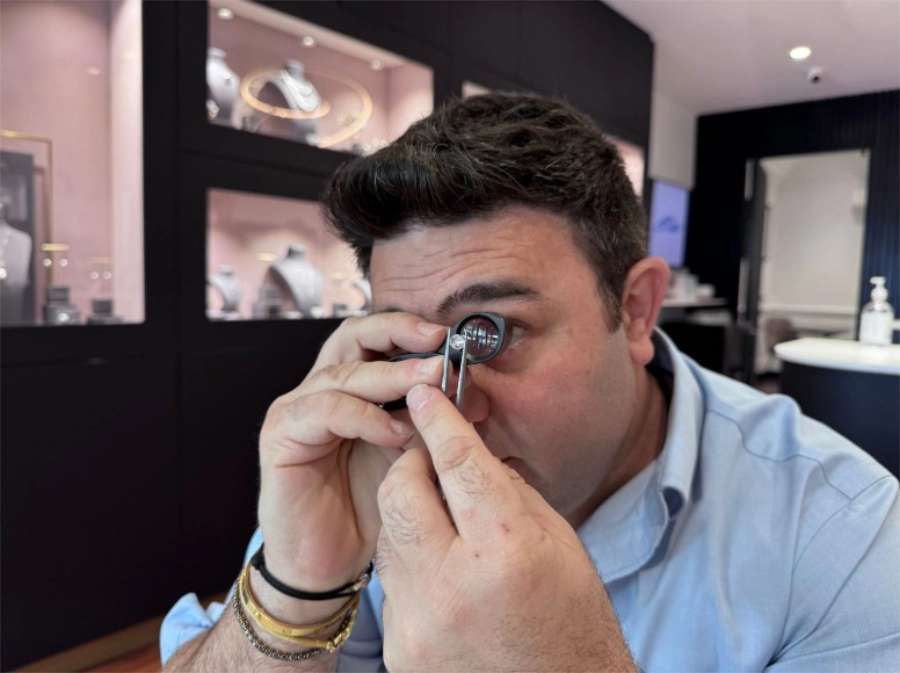
Diamond clarity is the measure of how clean a stone is internally and externally, and it is one of the four grading factors that decide what a finished engagement ring looks and costs. Couples coming through our Mt Hawthorn workshop often arrive worrying about clarity in particular: should they pay for a flawless diamond, or is a lower clarity grade fine for the ring they have in mind. The honest answer almost always sits somewhere in the middle, and the right place depends on the diamond shape, the carat weight and how the wearer’s eye reads detail.
This guide walks through what diamond clarity refers to, how the GIA clarity grading system works, where colour fits alongside clarity, and how we recommend balancing the two when you are choosing a stone.
What Diamond Clarity Refers To
Diamond clarity refers to the presence or absence of internal inclusions and external surface blemishes in a stone, observed under 10x magnification by a skilled grader. Inclusions are small features inside the diamond, often crystals of other minerals, tiny feathers, or growth patterns that formed under extreme heat and pressure as the stone developed. Blemishes are surface imperfections, sometimes called external imperfections, that may have come from cutting or polishing.
Nearly all diamonds carry some degree of inclusion. Truly flawless diamonds are extremely rare and command premium prices because of that scarcity. Most engagement ring diamonds we set sit in the middle clarity grades, where any inclusions are not visible to the naked eye and the stone reads clean to anyone looking at it from a normal distance.
The GIA Diamond Clarity Scale
The Gemological Institute of America established the diamond clarity scale used worldwide. The GIA diamond clarity scale runs from Flawless at the top to Included at the bottom, with each grade reflecting how easily inclusions and blemishes can be seen at 10x magnification.
| Grade | Code | Description |
|---|---|---|
| Flawless | FL | No inclusions or blemishes visible under magnification |
| Internally Flawless | IF | Only blemishes visible on the surface, no internal inclusions |
| Very, Very Slightly Included | VVS1 | Minute inclusions, difficult for even a skilled grader to see |
| Very, Very Slightly Included | VVS2 | Minute inclusions, very difficult to see under magnification |
| Very Slightly Included | VS1 | Minor inclusions visible under magnification but typically not to the naked eye |
| Very Slightly Included | VS2 | Minor inclusions visible under magnification, occasionally to the naked eye |
| Slightly Included | SI1 | Noticeable inclusions under magnification, sometimes visible to the naked eye depending on location |
| Slightly Included | SI2 | Noticeable inclusions under magnification, often visible to the naked eye |
| Included | I1 | Obvious inclusions, often visible to the naked eye, may affect transparency and brilliance |
| Included | I2 | Obvious inclusions affecting transparency and brilliance |
| Included | I3 | Severe inclusions affecting transparency, brilliance and durability |
For most engagement rings, we recommend somewhere between VS1 and SI1, depending on the cut. A round brilliant hides inclusions better than an emerald cut. A larger inclusion in the centre of the table is more visible than a similar inclusion near the girdle.

Inclusions And Blemishes Explained
Diamond inclusions come in many forms. The most common include pinpoints (very small mineral crystals), feathers (small fractures), clouds (groups of tiny pinpoints), needles (thin crystal inclusions), and crystals (larger included minerals visible inside the stone). Each is mapped on the diamond grading report, with a plot diagram showing inclusion location across the table and pavilion.
Surface blemishes include polish lines, naturals (small portions of the original rough surface left intact at the girdle), nicks and scratches. These rarely affect the appearance of a finished stone unless they are large enough to disrupt how light travels through the diamond. Inclusion location matters as much as size: an inclusion under the table draws the eye, while one near the girdle may be hidden by the prongs of the setting.
How Inclusions Affect A Diamond’s Appearance
Most VS and many SI grade diamonds look identical to higher clarity grade stones to the naked eye. The 10x magnification used by the gemmological institute is designed to reveal features that are not visible without help. A diamond clarity chart shows the differences between grades, but in practical terms, a VS2 stone and a VVS1 stone of the same colour, cut and carat weight will sparkle the same to anyone looking at the ring across a table.
Larger inclusions can affect the diamond’s beauty when they reduce light return. A heavily included stone may read slightly cloudy, with fewer of the bright flashes that give a well cut diamond its exceptional sparkle. For most buyers, the best clarity grade to chase is the lowest grade where the stone still reads clean to the naked eye. That is usually somewhere between VS2 and SI1 for white diamonds, and slightly higher for emerald and Asscher cuts where step faceting reveals more.
Where Clarity Fits In The Buying Decision
Clarity is one factor among four. Carat weight, diamond cut, diamond colour and clarity each affect the diamond’s appearance and the price. Spending budget on the highest clarity grade typically delivers less visible improvement than spending the same money on a better cut. A perfectly proportioned VS2 diamond with an excellent cut will outperform a VVS1 stone with a fair cut almost every time.
That said, certain cuts benefit from a higher clarity grade. Emerald cut and asscher cut step cut diamonds reveal inclusions more readily than brilliant cuts because of their long, parallel facets. For these shapes we recommend prioritising clarity slightly higher, ideally VS1 or above. For round brilliants, ovals, cushions, princess and pear cuts, the SI1 grade often delivers the best balance of value and visual quality.
Personal preference matters too. Some clients want the certainty of an internally flawless diamond and accept the premium prices for what that grade represents. Others prefer to put the saved budget into a larger stone, a richer setting, or a matched wedding band.
Diamond Colour In Brief
Diamond colour refers to the absence of yellow or brown tint in a white diamond. The GIA colour scale runs from D (colourless) to Z (light yellow or brown). D, E and F are colourless diamonds, the rarest and most expensive grades. G, H, I and J are near-colourless and read white in most settings to most viewers.
For most engagement rings, we recommend somewhere between G and I, depending on the metal. A G colour diamond set in white gold or platinum reads bright white. The same diamond set in yellow or rose gold can sit lower on the colour scale (J or even K) and still read clean because the warm metal absorbs any faint tint. Lab grown diamonds typically grade in the colourless range, which sometimes makes them read whiter than natural diamonds at a similar price point.
A Recent East Perth Commission
A couple from East Perth came to us with a budget that allowed them to choose between a 1.2 carat round in VVS1 / F colour, or a 1.6 carat round in SI1 / H colour at the same total cost. We laid both stones loose under the bench lamp, with magnification and naked-eye comparison, and walked through the diamond clarity chart with them.
The 1.6 carat stone won. The SI1 inclusion sat near the girdle where the prong would cover it, and the H colour read white against the platinum setting. We designed a hand-finished six prong solitaire with a tapered band and a hidden pavé accent under the gallery. Build time was six weeks. The proposal happened at Optus Stadium during a sunset cricket match. They have since returned for a matched eternity band and a clean for the engagement ring six months in.

How Diamond Shape, Size And Setting Changes What You See
Different shape families hide or reveal traits. Brilliant faceted shapes, round, oval, cushion, radiant, pear, break up the view into glitter and often mask tiny inclusions and a touch of warmth. Emerald and Asscher cuts have long, open facets. They reward slightly higher clarity and, in white metals, a cooler colour.
Carat weight shifts perception too. The larger the diamond, the easier it is to notice both colour and clarity. Around 0.70 to 1.00 ct, many couples love H to I with VS2 or eye-clean SI1. At 1.50 to 2.00 ct, G to H with VS is a popular balance. Above 2.00 ct, F to G with VS to VVS looks magnificently crisp in photos and in person.
Finally, settings influence both. A bright white pavé halo can make a warmer centre look warmer by contrast. A yellow gold setting lends a gentle glow that flatters slightly warm centres. Try your short-listed stones in the actual metal before you decide. Place them on a neutral card, even a simple spinner white decorative tray or plain white paper, then view them in the setting to see where the difference lies in context.
Frequently Asked Questions
A few of the diamond clarity questions we are asked most often.
What Is The Best Clarity Grade For An Engagement Ring?
For most engagement rings, VS1 to SI1 sits in the sweet spot where inclusions are not visible to the naked eye and the price is reasonable. Step cut diamonds (emerald, asscher) benefit from VS1 or higher because their faceting reveals inclusions more readily.
Are Flawless Diamonds Worth The Premium?
For most buyers, no. Flawless and internally flawless diamonds command significantly higher prices, and the visual difference compared to a well chosen VS2 or VS1 stone is invisible to the naked eye. The premium reflects rarity rather than appearance.
Do Lab Grown Diamonds Have The Same Clarity Grades As Natural Diamonds?
Yes. Lab diamonds are graded on the same GIA clarity grading system as natural diamonds, with the same scale from Flawless to Included. The grading process is identical because the stones are chemically and structurally the same.
What Is The Best Diamond Clarity For Larger Carat Weights?
Larger diamonds reveal inclusions more readily because there is more table to look through. For stones above two carats we typically recommend VS2 as the minimum, and SI1 only if the inclusion is well placed and the cut hides it effectively.
Can A Skilled Grader Tell The Difference Between Adjacent Clarity Grades?
Yes. Trained graders working under standardised lighting and 10x magnification can reliably distinguish VVS1 from VVS2, or VS2 from SI1. To a non-expert eye these differences are usually invisible, which is why we walk clients through stones in person rather than relying solely on the certificate.
See The Differences Side By Side
Reading clarity grades on paper is not the same as comparing them under a loupe. Two stones with the same carat weight, the same cut and the same colour can grade three steps apart on the clarity scale and still look identical to the naked eye, while a poorly placed inclusion two grades higher can be the more visible of the two. The only way to make this call honestly is at the bench, with a magnifier in your hand and the lights set up properly.
If you are at the clarity stage of your engagement ring decision, we invite you in for a side-by-side comparison. We will pull two or three loose stones across the clarity grades you are weighing, walk through the plot diagrams from the GIA report, and let you decide which inclusions you can live with and which you cannot. Arrange A Stone Comparison at our Mt Hawthorn studio, or take a first look through our Diamond Engagement Ring Collection for context on how clarity translates into a finished ring.

Stelios Palioudakis, founder of Stelios Jewellers, has been crafting bespoke pieces since 2007. Recognised early as a finalist in the Australian Jewellery Awards, Stelios has built a brand renowned for exceptional design, quality, and loyal clientele.



Social Media