

Before you buy an engagement ring, you need four decisions in place: the centre stone, the setting that holds it, the metal, and the budget you are working to. Everything else follows from those. Get the setting wrong and you will be back at a bench within two years. Get the stone wrong and you will overpay for something nobody can see.
This guide is for anyone buying an engagement ring in Perth or anywhere in Australia, whether you are proposing as a surprise or designing it together. It covers the basics properly, then 24 practical tips, then the mistakes we watch people make from behind the counter. It is longer than most guides because the short ones leave out the parts that cost money.
Stelios Jewellers is a family workshop at 145 Scarborough Beach Road in Mt Hawthorn, and our bench team carries more than 200 years of combined experience. Stelios trained for eight years before working unsupervised on a client’s stone. Our lead designer, Isabelle Pontis, has spent 27 years designing rings for Western Australian couples. The workshop is on site, which means the person who makes your ring is the person you can talk to about it.
The Journey To The Perfect Engagement Ring
Most people arrive with a photo and a number. That is a perfectly good starting point, and it is usually the wrong ring.
The photo tells us the aesthetic. The number tells us the constraint. Neither tells us whether a diamond is even the right stone, which is a question worth asking once you know why engagement rings are diamonds in the first place. What it does not tell us is how she uses her hands, whether she swims at Scarborough four mornings a week, whether one of you works a fly in fly out roster and needs a ring that survives a mine site, or whether there is a grandmother’s stone sitting in a drawer that should really be in this ring. Those conversations change the design more than any photo does.
We start with your vision, then we interrogate it a little. If a design will not survive the life it is going into, we will say so before we make it rather than after. That is the point of buying from a workshop rather than a display case.
Understanding The Basics Of Engagement Rings
Four elements make up every engagement ring. Understanding them in plain terms is enough to make you a competent buyer.
The Centre Stone
The centre stone is the focal point, and it usually takes the largest share of the budget. It can be a diamond, a coloured gemstone, or a pearl.
If you are choosing a diamond, the 4Cs govern quality: carat weight, colour, clarity and cut. Colour runs from D, meaning colourless, down to Z, meaning light yellow. Clarity runs from FL, meaning flawless, down to I3. Carat measures weight rather than size, which is why a carat equals exactly 200 milligrams and why two one carat stones can look different on a hand.
The useful shortcut is this. Above VS2, inclusions are invisible to the naked eye, so paying for higher clarity buys you a certificate rather than a better looking ring. Cut is the C worth spending on, because it determines how much light the stone returns. Read our full 4Cs of diamonds guide before you commit to grades.
The Ring Setting
The setting is how the stone is held, and it matters more for daily life than anything else on this list.
Prong settings, also called claw settings, hold the stone with metal fingers and let the most light in. They are the classic choice and they need their tips checked every couple of years. Bezel settings wrap a rim of metal around the stone. They protect it better than anything else, they suit anyone who works with their hands, and depending on how much metal is used they can make a stone read slightly larger or slightly smaller. Halo settings ring the centre stone with smaller diamonds, which adds visual size for less money than a bigger centre stone. Tension settings hold the stone by the pressure of the band itself, which looks remarkable and is genuinely difficult to resize later. Pavé settings run small diamonds along the band. Cathedral settings arch the shoulders up to meet the stone.
The Metal Type
In Australia you will mostly be choosing between 18ct and 9ct gold, in yellow, white or rose, and platinum.
Yellow gold is warm and needs no maintenance beyond polishing. White gold is yellow gold alloyed pale and then rhodium plated, and that plating wears off. Expect to re-plate every twelve to twenty four months depending on wear, which is a small ongoing cost most people are never told about. Rose gold gets its colour from copper in the alloy and is slightly harder than the other two. Platinum is denser, hypoallergenic and does not need plating. It scratches into a soft patina rather than wearing away, and it costs more per gram because there is more metal in the same ring.
Nine carat is harder and cheaper. Eighteen carat is richer in colour and holds detail better. Neither is wrong.
The Band Style
Band style is the overall design language. Solitaire puts everything on one stone. Halo adds a frame of small diamonds. Three stone rings, often read as past, present and future, spread the budget across three. Pavé, channel and eternity styles carry diamonds along the band.
The thing to think about here is the wedding band that has to sit next to it. A ring with a low gallery or an unusual profile can leave a visible gap, or need a fitted band shaped to it. Deciding that at design stage costs nothing. Discovering it a year later costs a second ring.
Beyond The Basics: Stelios Jewellers’ Approach
Most guides stop at the four elements above. Here is what we do differently.
Customisation
Every design starts as a conversation, then becomes a CAD model you approve before any metal is cut. You see the ring from every angle, at actual size, before we commit. Changes at that stage cost nothing. Changes after casting cost real money, which is why we would rather spend an extra week in design than rush it.
You can start the process yourself with our bespoke ring builder, or come in and sketch it with us.
Family Heirloom Remodelling
Roughly one in five engagement rings we make contains a stone that already belonged to the family. A grandmother’s solitaire in a worn setting, a stone from a ring nobody wears, sometimes a collection of small diamonds from several pieces.
We unset, assess and re-cut where it makes sense, then build something the wearer will actually put on. The sentiment survives. The 1970s illusion setting does not. If you have something in a drawer, bring it in before you buy a new stone. You can see examples of the work in our custom gallery.
Client Education
We would rather explain a grading report than sell around it. That means showing you why we would drop a colour grade to fund a better cut, or telling you that the stone you are looking at is priced above what we think it is worth. It occasionally costs us a sale. It has also brought back a lot of people for wedding bands, anniversary pieces and their children’s rings.
24 Tips For Buying An Engagement Ring
These are grouped in the order the decisions actually arrive.
Budget And Stone Choice
Start here, because these four choices set everything downstream.
1. Set a budget before you look at anything. The old rule about two or three months of salary came from a 1940s advertising campaign, not from anywhere sensible. A better question is what you can spend without resenting it in six months. Our guide to what an engagement ring costs covers what Australian couples actually spend.
2. Know the 4Cs, then spend them unevenly. Cut first, carat second, colour and clarity last. Most people do this in reverse.
3. Choose the shape before the specifications. Round cut diamonds account for roughly 70 per cent of sales and return the most light. Princess cut is sharper and more modern. Emerald cut is a step cut, so it flashes in broad planes rather than sparkling, and it shows inclusions more readily than brilliant cuts. Marquise cut diamonds and pear shapes look larger per carat but carry points that need protecting. Oval, cushion, radiant, rose cut and heart shaped diamonds all sit somewhere between.
4. Buy just under the magic weights. A 0.90 carat stone can cost noticeably less than a 1.00 carat stone and the difference is invisible on a finger. The same applies just under 1.50 and 2.00.
5. Consider lab grown honestly. Our lab grown diamonds buy more size and clarity for the same budget, and they will not hold value. Both facts are true at once. We compare them properly in lab grown versus natural diamonds.
6. Do not rule out coloured gems. Sapphire sits at 9 on the Mohs scale and makes an excellent everyday ring. Australian sapphires, our wider coloured stone rings and Western Australian pink diamonds all give you something a chain store cannot.
Setting, Metal And Fit
Now the practical decisions, which is where rings succeed or fail.
7. Match the setting to her hands, not to the photo. Nurses, hairdressers, gardeners, rock climbers and anyone in scrubs or gloves all do better in a bezel or a low profile claw setting.
8. Think about fly in fly out before you design. A significant share of Western Australian couples have one partner working a roster, and most sites will not allow rings on the tools. A ring that lives on a chain for two weeks at a time needs a different design brief, and a second, simpler band is often the smarter answer.
9. Pick the metal for maintenance, not just colour. If nobody in the relationship will remember to re-plate white gold, choose platinum or yellow gold instead.
10. View the stone in more than one light. Diamonds behave differently under showroom halogen, office fluorescents and Perth daylight, which is harsher than most showrooms admit. Take the ring to the window. Any jeweller worth buying from will encourage it.
11. Get the size right the first time. Fingers swell in summer and shrink in cold water, and a Perth February measurement is not a June measurement. If it is a surprise, we can work from a ring she already wears or estimate from photographs, and our guide on how to measure ring size walks through the methods that actually work. We resize once for free.
12. Design the engagement ring and the wedding band together where you can. Even if you only buy one now, knowing the second exists changes the first.
Protecting Your Purchase
Boring, and the part people skip.
13. Get a grading report on anything above 0.50 carats. A GIA report from the Gemological Institute of America tells you what you are buying, independent of who is selling it.
14. Insure it properly. Home and contents policies usually carry sub limits that will not cover a ring’s full value, and often will not cover it outside the house at all. Specialist jewellery cover such as QReport offers agreed value and worldwide protection. Read the relevant product disclosure statement rather than the summary.
15. Photograph the ring and keep the valuation somewhere separate. Both make a claim faster.
16. Have the claws checked every twelve to eighteen months. Retipping a claw costs very little. Replacing a lost centre stone does not.
17. Clean it yourself, gently and often. Warm water, a drop of mild dishwashing liquid, a soft toothbrush behind the stone where the film builds up. Skip the harsh chemicals and the supermarket ultrasonic.
18. Take it off for the beach, the gym and the garden. Cold water shrinks fingers, and Cottesloe has swallowed more rings than any of us would like to count.
Before You Commit
The last checks, and the ones that save arguments.
19. Ask what the price includes. Stone, setting, sizing, valuation and future maintenance are not always in the same number.
20. Ask to see the exchange and return policy in writing. Time frames, restocking fees and whether a custom piece is excluded. Understandably, bespoke work usually is.
21. Ask where the stone came from. A jeweller who cannot answer is a jeweller who did not ask.
22. Ask how long it will take. A bespoke ring is typically four to six weeks. Leave more if you have a date in mind.
23. Think about how it will look in twenty years, not twenty minutes. Trends move. Very ornate designs date faster than clean ones.
24. Visit a workshop, not just a showroom. Watching someone set a stone tells you more about a jeweller than any brochure. Ours is behind the counter in Mt Hawthorn and you are welcome to watch.
Common Mistakes To Avoid In Engagement Ring Shopping
These are the ones we see most often, in rough order of how expensive they are to fix.
1. Buying clarity nobody can see. Paying for VVS1 when VS2 looks identical is the most common way to waste a thousand dollars.
2. Choosing a setting that does not suit her job or her hobbies. The most beautiful ring in the world is worthless if it lives in a drawer.
3. Ignoring the wedding band. A ring designed in isolation frequently will not sit flush with anything.
4. Guessing the ring size from a friend’s finger. It is not a reliable proxy. Ask us instead.
5. Assuming home insurance covers it. Check the sub limit and check whether cover extends outside the house.
6. Skipping the grading report on a significant stone. Without one you are trusting a description, not a measurement.
7. Choosing white gold without knowing about re-plating. Then being annoyed in eighteen months when it turns warm at the shoulders.
8. Buying a tension or full eternity setting without asking about resizing. Some designs cannot be sized more than a fraction, which matters over a lifetime.
9. Treating the ring as an investment. Almost no engagement ring resells for what it cost. Certified fancy coloured stones are the exception, and they are covered on our investment stones pages.
10. Rushing the timeline. Bespoke work compresses badly. Six weeks of design becomes a fortnight of compromise.
11. Not asking about aftercare. Find out who cleans, sizes and repairs it, and what that costs, before you buy.
12. Buying alone when you did not need to. Surprise proposals are wonderful. So is a ring she helped choose. Roughly half our clients now design together, and nobody has ever complained about it.
Frequently Asked Questions
These come up across the counter almost every week.
How Much Should I Spend On An Engagement Ring?
There is no correct figure. Australian couples commonly spend between $5,000 and $10,000, though we make rings well below and well above that. Spend what you can comfortably spend and put the money into cut and setting quality rather than certificate grades.
What Is The Most Popular Diamond Shape?
Round brilliant, at roughly 70 per cent of sales. It returns the most light of any shape. Oval and emerald cut have both grown strongly in the last few years.
Can An Engagement Ring Be Resized Later?
Most can, within a size or two. Full eternity bands, tension settings and rings with stones set all the way around are the difficult ones, which is worth knowing at design stage rather than later.
Should I Get The Ring Insured Separately?
Usually yes. Home and contents cover often carries a sub limit below the ring’s value and may not cover loss away from the house. A specialist jewellery policy with an agreed value is the safer option.
How Long Does A Custom Ring Take To Make?
Four to six weeks for most bespoke pieces, from first consultation to collection. Sourcing an unusual stone or a complex setting can add to that.
Can I Use A Family Stone In A New Ring?
Yes, and we do it often. We assess the stone first, because older cuts sometimes need re-polishing and some stones have damage that is not visible while they are set.
A Ring Made For The Person Wearing It
Buying an engagement ring comes down to a small number of decisions made well. Choose the setting for the life it is going into. Spend on cut before certificates. Insure it properly, get the claws checked, and design it alongside the band that has to sit next to it. Do those five things and the ring will still be right in thirty years.
What has changed most in our time at the bench is that fewer people want the biggest stone their budget allows, and more want something nobody else has. That suits us. We are a workshop, not a catalogue.
Come and see us at 145 Scarborough Beach Road in Mt Hawthorn. You can look at stones under real daylight, watch the bench working, and talk through your design with the people who will make it. If spreading the cost helps, we work with Achievement Finance, which we chose after turning down every other option we were offered.
Book a consultation with Stelios Jewellers, or browse our engagement rings to see where to start.
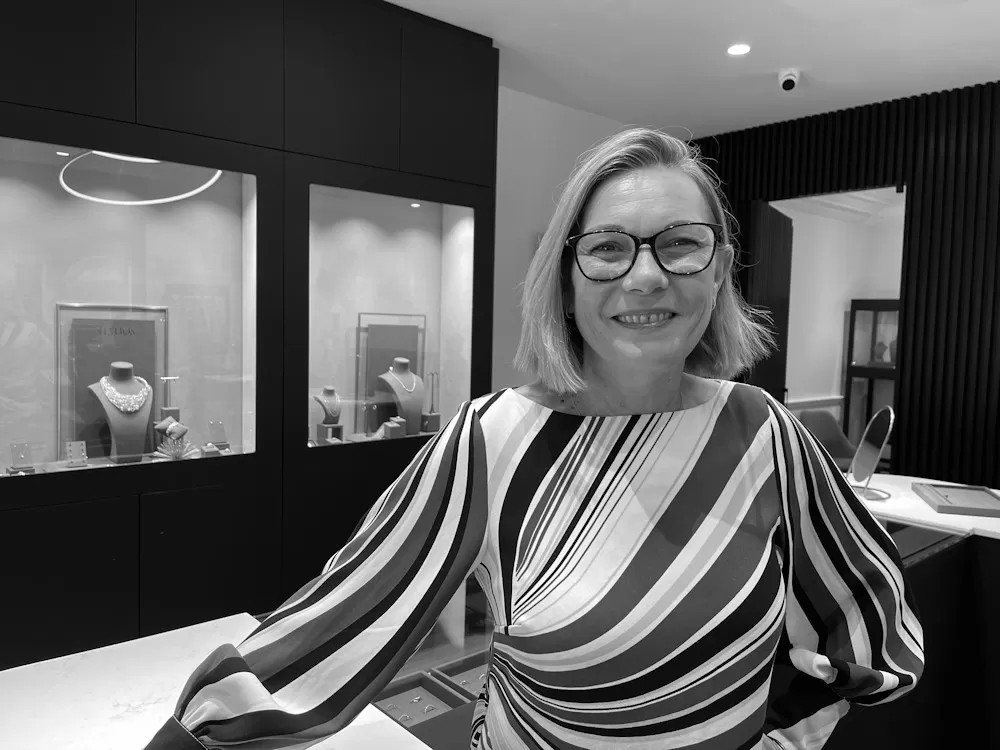
Isabelle Pontis, lead designer at Stelios Jewellers, brings 27 years of experience and a renowned eye for detail. Her bespoke designs blend technical mastery with artistic vision, shaping the signature style and quality of Stelios Jewellers.



Social Media