
Men’s engagement rings are not new, they are just newly normal.
They existed in fifteenth century Europe, disappeared for most of the modern era, and were pushed hard by American jewellers in the 1920s and 1930s in a marketing campaign that comprehensively failed. What actually normalised rings on men’s hands was the Second World War, when large numbers of servicemen wore wedding bands as a reminder of home and brought the habit back with them.
The engagement ring took another eighty years. What changed it was partly same-sex couples, who had no reason to observe an asymmetry that only ever made sense in one direction, and partly a broader sense that if one person is going to be visibly spoken for, both probably should be.
We build them regularly at our Mt Hawthorn studio, and the brief is genuinely different from a women’s ring. This covers what to know.
Do Men Wear Engagement Rings?
Increasingly, and without much fuss about it.
There is no convention to follow, which is the appeal and the difficulty. A women’s engagement ring arrives with two hundred years of expectation attached. A men’s ring arrives with almost none, so it can be whatever the wearer will actually put on every day.
The most common brief we get is some version of “something I will not notice I am wearing”. That is a design instruction, not a lack of interest, and it points straight at low profile, hard wearing and comfortable.
Which Hand And Which Finger
In Australia the fourth finger of the left hand is standard for both partners, and plenty of men wear it there.
Quite a few choose the right hand instead, either to distinguish an engagement ring from the wedding band that will follow, or simply because it suits them. Both are entirely normal here. Our guide on what hand the wedding ring goes on covers the cultural variations, which matter in a city as mixed as Perth.
If a wedding band is coming later, decide now whether the two will share a finger or sit on opposite hands. It changes the width you should be choosing today.
Styles That Suit A Men’s Engagement Ring
Six directions cover almost everything we make.
- The classic band. Clean, minimalist, no stones. Still the most requested, and the hardest to get wrong. All the character comes from the metal, the width and the finish.
- Flush or gypsy set. A stone set down into the metal so its table sits level with the surface. Nothing protrudes, nothing catches, and it is by a distance the best way to put a diamond on a hand that works. If you want a stone and a practical ring, this is the answer.
- Bezel set. A single stone held by a rim of metal. More visible than flush setting, still protected. Covered in more depth in our settings guide.
- Textured. Hammered, brushed, sandblasted or matte finishes. Worth knowing that a brushed finish hides everyday scratching far better than a high polish, which is a practical advantage rather than only an aesthetic one.
- Signet or wide statement. More presence, often with engraving or a flat top. Suits larger hands and anyone who already wears rings.
- Mixed material. Precious metal with an inlay of carbon fibre, timber, meteorite or a contrasting metal. Distinctive, and worth understanding the repair implications before committing, which we will come to.
Stones are not off the table either. Black diamonds, salt-and-pepper diamonds, sapphires and other coloured stones all read well in a men’s ring, usually better in a flush or bezel setting than a claw.
Metals And Materials
This is where men’s rings differ most from women’s, and where the worst decisions get made.
- Gold. 18 carat is 75 per cent pure and 9 carat is 375 parts per thousand. Yellow, white or rose, all resizable, all repairable, all reworkable in thirty years. Our yellow versus white versus rose gold guide covers the differences.
- Platinum. Around 95 per cent pure, heavier in the hand, naturally white and needs no plating. It also holds up to daily abuse better than gold does. The comparison is in gold versus platinum.
- Titanium and tantalum. Light, strong, hypoallergenic. Tantalum in particular has become popular for its dark grey colour and it can be worked reasonably well.
- Tungsten carbide and ceramic. Extremely scratch resistant and very cheap, and here is the part the online sellers do not mention. They cannot be resized at all, and they cannot be repaired. Tungsten is brittle rather than tough, so a hard knock shatters it rather than denting it. Fingers change size across a lifetime, so a ring you can never adjust is a ring with an expiry date.
Our honest position is that a precious metal ring can be resized, retipped, re-finished and eventually remade around the same metal. An industrial one cannot. For a ring meant to last, that difference matters more than the scratch resistance you are being sold.
Width, Profile And Comfort Fit
Men’s rings typically run 5mm to 8mm wide, against 2mm to 4mm for most women’s bands, and width changes everything about how a ring feels.
A wider band contacts more of your finger, so it feels tighter at the same nominal size. As a rule we size up between a quarter and a half size for anything 6mm or wider, and we check it on the actual finger rather than trusting the conversion.
Comfort fit means the inside of the band is domed rather than flat, so it rolls over the knuckle instead of catching. On a wide ring it is not a luxury. We build almost all men’s bands this way and most people notice the difference immediately.
Profile matters too. A flat band with sharp edges reads architectural and catches more. A rounded court profile is the most comfortable for continuous wear. Try all three before you decide, because it is obvious on a hand and invisible in a photograph.
Getting The Size Right
Men’s fingers are less predictable than people expect, and Perth makes it worse.
Fingers swell in heat, and a ring sized on a 40 degree February afternoon will feel loose in August. They also swell after exercise and shrink in cold water. We size against a finger at a neutral temperature, and where possible we size the same finger twice on different days.
The other complication is that men’s fingers often taper less sharply than women’s, so a ring that passes the knuckle can end up too loose at the base or vice versa. This is exactly what the silver prototype stage is for. Every commission moves from 3D rendering to a silver prototype you can wear for a week before anything is cast, and interstate clients get theirs posted out. A week of real wear tells you what ten minutes in a showroom cannot. Our ring size guide covers the basics.
Rings, Work And Safety
Nobody writes this section and it matters more here than almost anywhere in the country.
Most mine sites, and many workshops and hospitals, prohibit rings on the tools. That is not fussiness. Ring avulsion, where a ring catches on machinery and strips the tissue from the finger, is a genuine and serious injury, and it is the reason the rules exist.
For clients on a fly in fly out roster or in the trades, we usually make two things. The real ring, in a precious metal, worn at home and away from site. And a cheap silicone band for work, which tears away under load by design. Nobody should be choosing between wearing their engagement ring and keeping their hand.
If the ring will be worn while active, keep it low, keep the stones flush and skip anything with claws.
Matching His Ring To Hers
There is no requirement to match, and a fair share of couples deliberately do not.
Where couples do want a connection, it rarely works to simply scale one design up. A 2mm halo enlarged to 7mm looks wrong. What works better is a shared detail: the same metal, the same finish, an engraving in the same hand, or the same stone type in very different settings.
Where the rings will sit next to each other on the same finger, or where both partners wear a stack, the pairing needs designing rather than assuming. Our guide on engagement ring versus wedding band covers how two rings share a finger.
Caring For The Ring
The routine is simple and the same as any fine ring.
Wash it weekly in warm soapy water with a soft bristled toothbrush, paying attention to the inside of the band where oils build up. Skip harsh chemicals and take it off before pool chlorine. Brushed and matte finishes will gradually polish themselves smooth at the high points through wear, and we can re-texture them during a service.
Every ring we make comes with a complimentary annual clean and inspection, and our guide to cleaning a ring at home covers the method between visits.
Frequently Asked Questions
The six we field most often about men’s rings.
Do Men Wear Engagement Rings In Australia?
Increasingly, yes. There is no convention either way, which means the ring can be designed around what he will actually wear rather than around expectation.
Which Hand Does A Man Wear An Engagement Ring On?
Either. The left ring finger is standard in Australia, and plenty of men choose the right to distinguish it from the wedding band that follows.
How Wide Should A Men’s Ring Be?
Most sit between 5mm and 8mm. Wider suits larger hands and reads more substantial. Anything 6mm or over usually needs sizing up slightly.
Should I Avoid Tungsten Or Ceramic?
For a ring meant to last, yes. Neither can be resized or repaired, and tungsten shatters rather than bending. Fingers change over a lifetime and those rings cannot follow.
Can A Men’s Engagement Ring Have Diamonds?
Certainly. Flush or gypsy setting is the most practical approach, since the stone sits level with the metal and nothing protrudes to catch.
Can He Wear It On Site?
Usually not. Most sites prohibit rings for safety reasons. A silicone band for work and the real ring at home is the standard solution.
Come And Try Some On
Men’s rings are decided by feel far more than by appearance, and feel does not survive a photograph.
Come to our Mt Hawthorn studio and put a 5mm next to a 7mm on your own hand. Feel what comfort fit actually does over a knuckle. Handle platinum against 18 carat gold and understand why one weighs what it does. Then tell us what your hands do all day, because that will shape the design more than any style preference.
The bench behind the counter carries close to two centuries of combined experience, and master jeweller Paul holds two Jewellery Association of Australia Awards. Every ring is made on site and every one comes back to us for servicing rather than being sent away.
Browse our wedding bands and engagement rings, or start shaping something with the bespoke ring builder.
Book a consultation and bring both of you if the design is a joint decision.
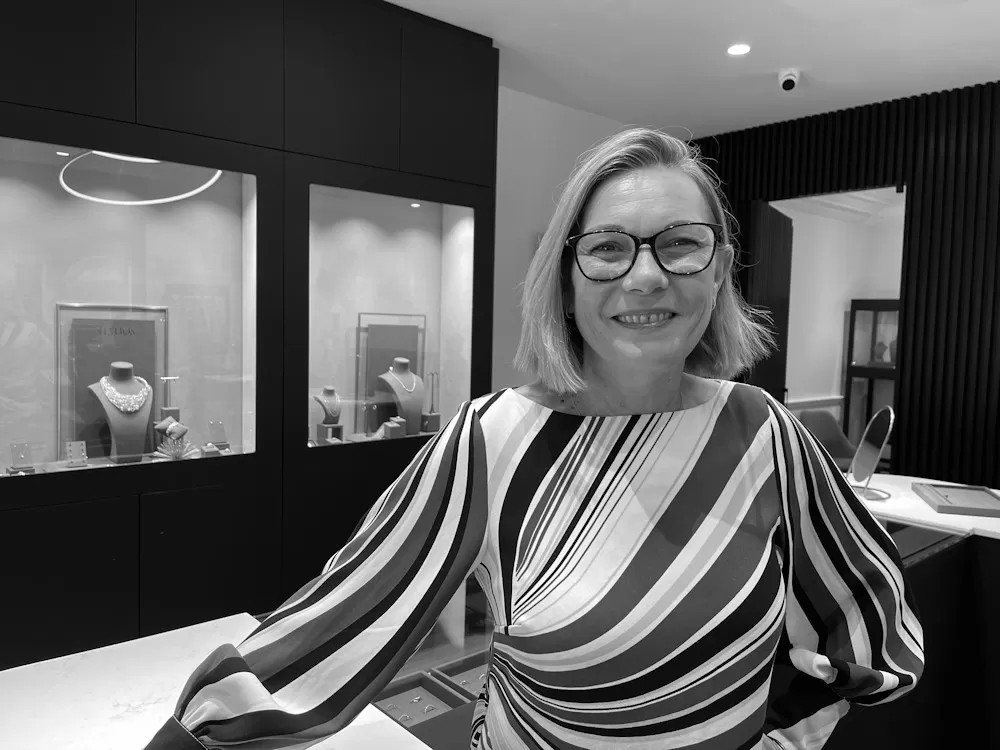
Isabelle Pontis, lead designer at Stelios Jewellers, brings 27 years of experience and a renowned eye for detail. Her bespoke designs blend technical mastery with artistic vision, shaping the signature style and quality of Stelios Jewellers.



Social Media