
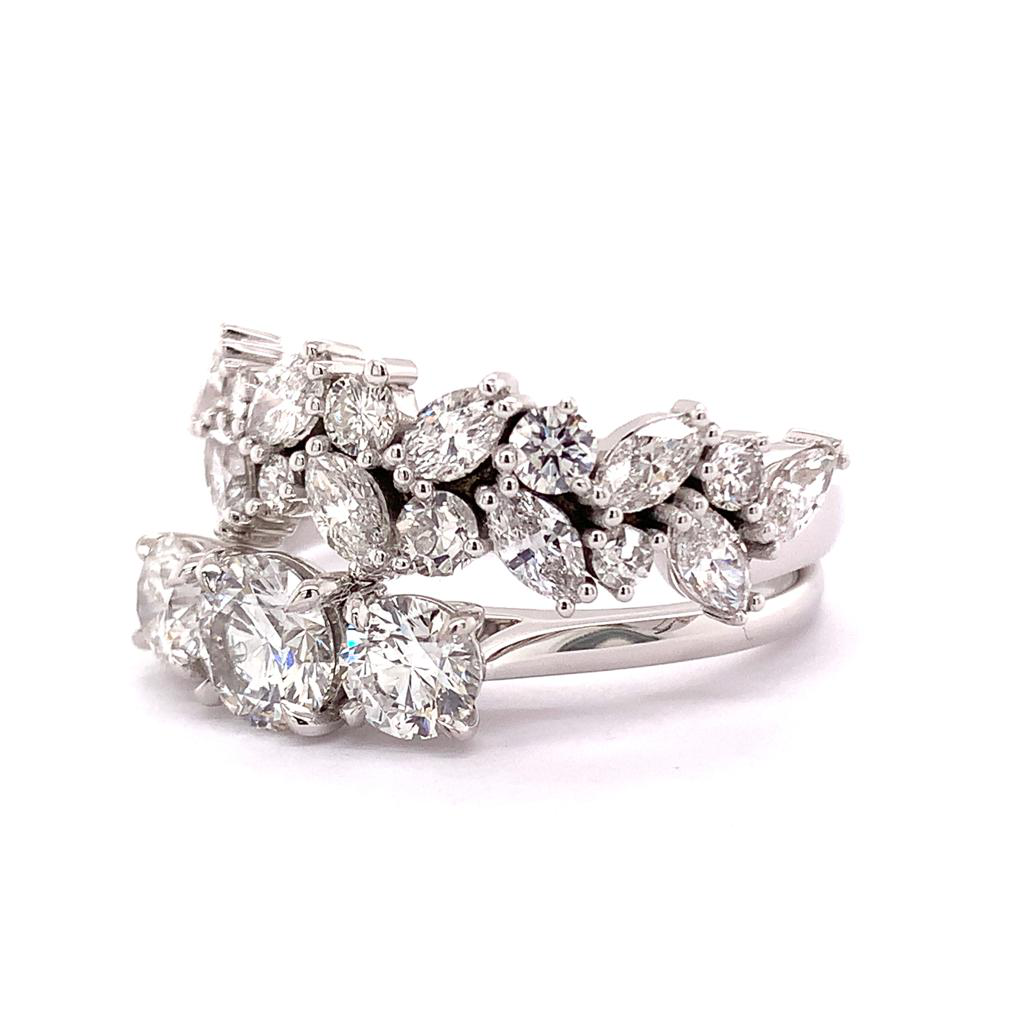
A ring stack is what most brides end up with whether they planned one or not. Engagement ring. Wedding band. Something at year five. Something else at ten. A thin gold band when a child arrives, or a grandmother’s ring finally brought out of the drawer and given a job. By year fifteen the finger reads like a short biography.
Stacking looks effortless from the outside and it is not. Rings that sit beautifully together on one hand can fight on another. Two metals that looked matched under showroom lighting can separate completely in Perth daylight. Widths that seemed modest on their own can swamp a small finger once they are stacked three deep.
This guide covers how we approach stacks at our Mt Hawthorn studio, from the first pairing of engagement ring and wedding band through to a four-ring stack built over a decade. It is for anyone about to add a ring, or about to buy the first two and wondering what comes next.
We have been designing stackable rings for Perth couples since Stelios Palioudakis took over the studio at 145 Scarborough Beach Road in 2007, and we add to existing stacks for long-standing clients most months of the year. Stelios himself said it best when we asked him why he still does this: jewellery outlives us, and it keeps connections between generations alive. A stack is that idea made literal.
What Stacking Means And Why People Do It
Ring stacking means wearing more than one ring on the same finger, combined deliberately rather than accumulated by accident.
If you wear an engagement ring and a wedding band, you already have a two-ring stack. Everything after that is a decision.
People stack for four broad reasons.
● Marking milestones. An anniversary, a birth, a promotion, a recovery. Something worth making tangible.
● Presence. A visual weight on the finger that one ring cannot deliver on its own.
● Redistributing an heirloom. A ring inherited from a mother or grandmother, brought into daily wear instead of living in a jewellery box.
● Working around a worn band. Some clients would rather add a new ring than resize a wedding band that has thinned over twenty years.
There is a fifth reason people rarely say out loud. A stack lets the original rings stay exactly as they were on the wedding day while acknowledging that a great deal has happened since.
The Starting Point: Engagement Ring And Wedding Band
Every stack begins with how these two sit together, and that pairing sets the rules for everything added later. Three things to get right now rather than in five years.
Profile
A wedding band that sits flush against the engagement ring looks and feels different from one that stands off it. If your engagement ring has a raised setting, a tall centre stone or an unusual gallery, a contoured band shaped to nest against it is the answer.
We cut those to the ring, not to a template. If the engagement ring came from somewhere else, bring it in and we will shape the band around it.
Metal Match Or Deliberate Contrast
Most couples match the wedding band metal to the engagement ring. Some contrast deliberately, usually yellow gold against white gold or platinum. Both work. What does not work is contrast that happened by accident because nobody thought about it, which is easy to spot and impossible to unsee.
Width Balance
The band is generally matched to the engagement ring shank or sits about 1mm narrower. A band noticeably wider than the shank overpowers the ring it is meant to support. If you are buying both at once, design them together. It costs nothing at the design stage and it is the single most common regret we hear later.
Adding A Third Ring To The Stack
Most stacks grow past two at a milestone. A fifth or tenth anniversary, a fortieth birthday, a first child. The third ring is where the decisions get more interesting, because it either pulls the first two together or exposes them.
● Half eternity diamond band. Diamonds along the top half only. The most popular third ring we make, and it can be resized later, which matters over a lifetime.
● Full eternity diamond band. Stones all the way around. More presence and more money, and it cannot be resized conventionally. Only worth it if finger size is stable.
● Plain contoured band. Width without sparkle. The right call when the engagement ring is already detailed and the stack risks becoming noisy.
● Coloured gemstone eternity band. Sapphires, rubies, emeralds or birthstones. Our coloured stone work goes into a lot of these, and they sit beautifully against a white diamond centre.
● Pink diamond accent band. Western Australian pink diamonds in a slim band. Genuinely rare now that the source mine has closed, and something no chain store can put in front of you.
● Pearl or signet ring. Less common alongside an engagement ring and usually worn on the other hand, though pearl rings turn up in stacks more often than people expect.
The third ring usually sits below the wedding band, closest to the knuckle, so the engagement ring stays dominant when you look down at your own hand.
Mixing Metals And Textures
A single-metal stack reads as considered and calm. A mixed metal stack reads as modern and personal, but only when the mix has been thought about.
Four rules we work to.
Two metals are interesting, three are a project. If you are combining rose, yellow and white, one has to dominate and the others have to behave like accents. Four is almost always too many.
Keep widths close when metals differ. Different colours at different widths creates visual noise, and it shows up worst on a smaller finger.
Finish matters as much as colour. A polished yellow gold band and a brushed yellow gold band read as two different rings. Mixing finishes within one metal is an underused way to add interest without adding a second colour.
Watch hardness differences. This is the one people are never told. A softer metal worn against a harder one loses. Platinum sitting next to 9-carat gold will slowly wear a groove into the gold over decades of contact. It is not a reason to avoid the combination, but it is a reason to check the stack annually.
Combinations we design most often: rose gold beside white gold for warm against cool, 18-carat yellow gold beside platinum for traditional colour with modern weight, and a yellow gold engagement ring stacked with a white gold eternity band and a matching white gold wedding band, where the eternity ring does the work of bridging the two.
Getting The Proportions Right
Stacking is arithmetic as much as taste. Four guidelines catch most of the mistakes we see.
Add up the widths. Total the band widths across the stack. Past roughly 10mm the stack starts to feel heavy on most hands. Petite fingers should cap nearer 7mm.
Visual weight is not metal weight. A 3mm diamond eternity band reads far heavier than a 3mm plain band, because stones catch light and pull the eye.
Leave some air. A stack that crowds hard against the knuckle sits differently from one that stops short. A small gap at the top is not a flaw, it is breathing room.
The engagement ring stays the anchor. Everything else is context.
One local note. Fingers swell in a Perth February and shrink in an August southerly, and a stack sized on a hot day can feel tight in winter or the reverse. We size stacks with that swing in mind. If you are unsure how the maths will land on your hand, bring the rings in. Photographs never capture proportion honestly, and our ring size guide will only get you so far on a multi-ring stack.
A Recent Stack We Built Over Ten Years
A client from Wembley came in a decade ago for her engagement ring. A 1.2 carat round brilliant in 18-carat yellow gold, six-claw solitaire, nothing complicated. She married the following year and we made a plain matching yellow band, 2mm.
At her fifth anniversary she wanted something to mark it and had no idea what. We spent an afternoon putting bands on her hand until one obviously worked: a half eternity in white gold, 0.7 carats of small diamonds across the top. The white metal broke up the yellow without stealing anything from the solitaire.
Earlier this year she came back for the ten-year mark, this time with two children in tow and considerably less time. She left with a slim 1.5mm contoured rose gold band, sized to nest against the eternity ring.
Three metals on one finger should have been a mess. It was not, and the reason is unglamorous: every ring had been designed knowing the next one was probably coming. The stack reads as intentional because it was.
Across a decade it came to roughly $14,000, spread over three conversations and three moments that mattered to her. The first ring was the anchor. Everything after it was context.
Common Stacking Approaches
Some patterns come through the door more than others.
● The matching set. Engagement ring and band in one metal, designed as a pair. Where most couples begin.
● The eternity addition. The matching set plus a half or full eternity band at an anniversary.
● The mixed metal trio. Three rings, three metals, balanced against each other.
● The milestone tower. Four or five narrow bands added over years, each tied to a specific event. Individually modest, collectively striking.
● The heirloom bridge. Engagement ring and band stacked with an inherited ring. These are the ones we take the most care over, because the heirloom usually cannot be replaced if the design goes wrong.
● The two-hand split. Engagement and wedding rings kept clean on the left, anniversary and heirloom rings built up on the right. Worth reading alongside our guide on what hand the wedding ring goes on.
The best stack is the one that holds together visually and means something to the person wearing it. Those two things are not in conflict as often as people assume.
When To Add A Spacer Or Leave Space
A spacer band is a thin plain ring used to separate two rings that would otherwise clash, either visually or by grinding against each other.
They earn their place in three situations. When two rings have complicated side profiles that catch on one another. When two eternity bands would hide each other’s stones if pushed together. And when you want deliberate negative space in the stack for rhythm rather than for function.
Spacers usually run 1mm to 1.5mm and are made in whichever metal ties the neighbouring rings together. Plenty of stacks never need one. That decision gets made on the finger, not in the abstract.
Frequently Asked Questions
The questions that come up most across our counter.
How Many Rings Can I Stack On One Finger?
Two to four sits comfortably on most hands. Past four the stack starts interfering with everyday movement and the total width usually pushes beyond 10mm, which reads bulky. Petite fingers should stop earlier.
Can I Mix Metals In A Ring Stack?
Yes, and mixed metal stacks have become the norm rather than the exception. Two metals reads as intentional, three works if one clearly dominates, four starts to look accidental.
Should The Engagement Ring Still Be The Centrepiece?
Usually. Anniversary and eternity bands are there to support it. When a later ring is meant to take over as the focal point, that is a design decision worth making openly rather than by accident.
Can I Resize A Full Eternity Band Added To The Stack?
Not conventionally, because the stones run the full circumference. A significant change in finger size means remaking the ring. Half eternity bands resize without drama, which is why we steer most clients toward them.
How Much Should I Spend On An Anniversary Ring?
Most of our clients land between $2,500 and $8,000. Plain contoured bands sit at the lower end, diamond eternity bands and coloured gemstone additions at the upper.
Can I Stack Rings On The Other Hand Instead?
Absolutely. Plenty of clients keep the engagement and wedding rings as a clean pair on the left and build a separate collection on the right. It gives the original pairing room to breathe and the new stack room to grow.
Come And Build Your Stack With Us
A stack is not something you finish. It is something you add to, which is why the first two rings matter so much and why the third is worth thinking about before you need it.
If you are considering the next ring, or buying the first two and want to leave the door open, the decisions are far easier in person. Come to our Mt Hawthorn studio, where the workshop sits behind the counter. We will try combinations on your actual hand, talk through what the ring after next might be, and design toward the stack you want at year fifteen rather than the one that suits this weekend.
Between the bench we carry roughly two centuries of experience, master jeweller Paul holds two Jewellery Association of Australia Awards, and every commission passes through at least two pairs of hands before it leaves the building. The same team handcrafts the Miss Universe Australia crown and the brooches worn by the West Australian Symphony Orchestra. Your third ring gets the same attention.
Browse our wedding bands, look through the custom gallery, or start designing with our bespoke ring builder.
Book a stacking consultation and bring the rings you already own.
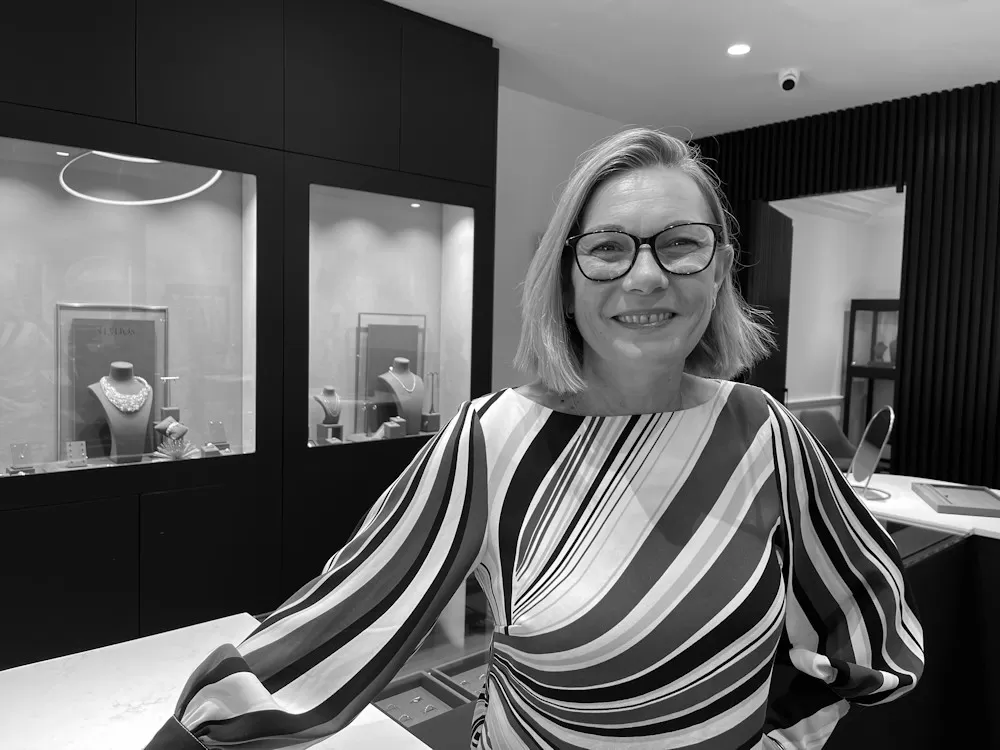
Isabelle Pontis, lead designer at Stelios Jewellers, brings 27 years of experience and a renowned eye for detail. Her bespoke designs blend technical mastery with artistic vision, shaping the signature style and quality of Stelios Jewellers.



Social Media