
The same ring looks like two different rings on two different hands.
A 1.5 carat oval solitaire that reads as elegant and substantial on one hand can read as either delicate or overwhelming on another, and nothing about the ring has changed. What changed is the proportion, and proportion is almost entirely absent from the way engagement rings are sold online.
This is a practical guide to how stone shape, band width, setting height and metal colour behave on wider and on smaller fingers. We measure hands every day at our Mt Hawthorn studio, and the difference between a ring someone loves and a ring someone tolerates is far more often proportion than budget.
Proportion Is The Whole Game
Two numbers do most of the work here, and neither is carat weight.
The first is face-up dimension, meaning how many millimetres of stone sit across the top. Carat measures weight, not size, and the two diverge considerably by shape. A one carat round measures around 6.5mm across. A one carat oval measures roughly 7.7mm by 5.7mm. Same weight, noticeably more finger coverage, which is why we quote face-up millimetres alongside carat when proportion is the question.
The second is band width relative to finger width. A 2mm band on a broad finger reads as a thin line with a lot of skin either side. The same 2mm band on a slender finger reads as substantial. Neither is wrong. They are simply different pictures.
Everything below follows from those two.
Rings For Wider Fingers
The goal is balance rather than disguise. A ring that is too small for the hand it sits on will look lost, and looking lost is what makes people self conscious, not the hand.
Stone Shapes That Work
Elongated shapes lengthen the visual line of the finger, which is the single most useful optical effect available. Oval, marquise, pear and elongated cushion all run up the finger rather than across it and spread more surface area face up per carat than a round does.
Marquise is the most efficient of these by some margin. Its two pointed ends give the greatest finger coverage per carat of any shape, and its silhouette draws the eye lengthways.
Cushion cuts are worth considering for a different reason. They carry more visual structure than a round, so they hold their own on a broader hand without needing to be enormous.
Round is not off the table, and plenty of people with broad hands specifically want one. It simply needs a little more size to sit in proportion. Our guide on how to choose a diamond shape covers the full range.
Band Width And Taper
This is where most of the difference gets made, and most people never think about it.
A medium to wide band, roughly 2.5mm to 4mm, sits in proportion on a broader finger in a way a very thin band does not. Too thin and the band all but disappears, which by contrast emphasises exactly what most people were hoping to balance.
A tapered band, narrower at the shoulders as it approaches the stone and slightly wider at the base, is quietly one of the best tools available. It draws the eye upward toward the centre stone and away from the width of the shank.
Comfort fit matters more here than anywhere. A wide band with a flat inner surface presses across more of the finger and feels tight even at the correct size. A domed interior rolls over the knuckle and reduces friction between fingers, and on a wide band it is not optional.
Settings Worth Considering
Three stone settings give horizontal coverage that a solitaire cannot, spreading presence across the finger rather than stacking it upward.
Halo settings add width and sparkle without adding bulk, which is useful when you want the ring to read larger without a much larger centre stone. A hidden halo does something similar in profile rather than face up.
Low to medium profile settings sit closer to the finger and are more comfortable across a full day. Our settings guide covers the mechanics of each.
What To Approach With Care
Very thin bands. Under about 1.5mm they can pinch on a broader finger and, as above, work against the proportion you were after.
Very small centre stones in very ornate settings. Detail competes with the hand rather than complementing it, and the effect is busy rather than delicate.
None of these is a prohibition. They are things to try on before committing rather than things to avoid.
Rings For Smaller And Slender Fingers
Here the risk runs the other way. The ring is more likely to overwhelm the hand than to disappear on it, and stones read considerably larger than their carat weight suggests.
Stone Shapes That Work
Round and pear both suit narrower fingers well. Round sits compactly and reads in proportion without needing size. Pear gives a little length without the width of an oval.
Oval works beautifully on slender hands too, and it is worth knowing that on a small finger an oval can read as very large indeed. That is often exactly the point.
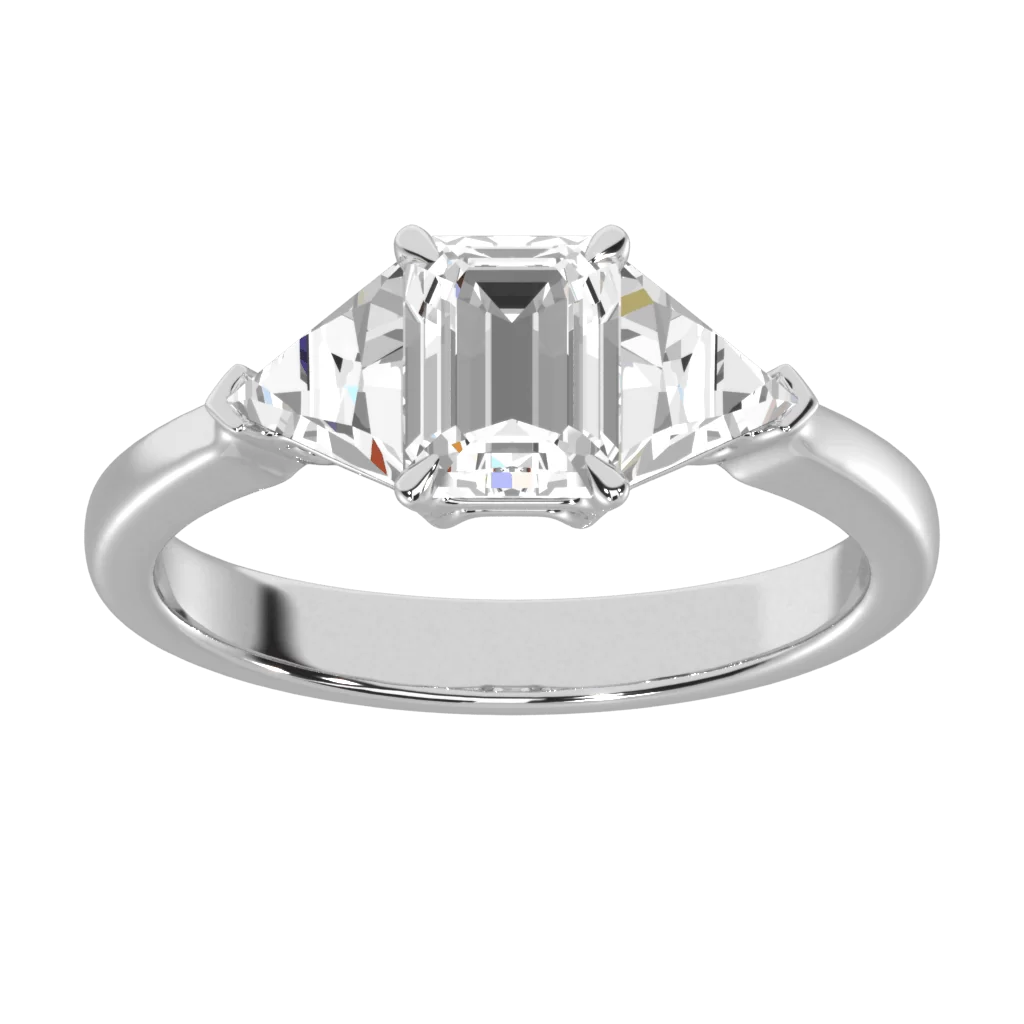
Emerald and Asscher suit slender hands particularly well, because their clean geometry reads elegant rather than heavy.
Band Width And Proportion
Dainty bands of roughly 1.5mm to 2mm keep the proportions light and let the centre stone do the work. On a size H or I finger a 2mm band already reads as substantial.
The trade-off is durability. A very fine band has less metal in it, wears through faster and is more prone to distortion. If you want a band under 1.5mm, platinum is worth the money because it retains metal where gold sheds it. Our gold versus platinum guide explains why.
Settings Worth Considering
Simple solitaires and low bezels flatter smaller hands, because they let the stone read at its actual size without competing detail.
Small accent stones rather than large ones. A fine pavé shoulder adds sparkle in proportion. A wide chunky halo can swallow a small hand.
East-west settings, where an elongated stone sits horizontally across the finger, work unexpectedly well on narrow fingers and are among the more modern designs leaving our bench.
What To Approach With Care
Very elaborate settings. Double halos, heavy cathedral arches and wide shoulders all add visual mass that a smaller hand does not need.
Very large carat weights without trying them first. A 2.5 carat stone on a size G hand is a striking look and a genuinely different one from the same stone on a size P. Try it before you decide, not after.
Carat Weight And Visual Presence
The number on the certificate is the least useful figure in this entire conversation.
A one carat round on a size G finger reads dramatically larger than the same stone on a size R, because the ratio of stone to finger has changed. We have had clients arrive certain they needed two carats and leave with 1.2, not because of budget but because 1.2 was simply the right size for the hand.
Small to medium carat weights suit petite fingers well, and that is not a compromise. On the other side, a broader hand can carry a larger stone without it reading as showy, which is a genuine advantage.
The practical answer is to stop shopping by carat and start shopping by millimetres and by what it looks like on the actual hand. Lab grown diamonds change this calculation too, since they buy considerably more face-up size for the same money. We cover the trade-off in lab grown versus natural diamonds.
Metal Choice And Visual Weight
Colour affects perceived mass, which is subtle and real.
White metals recede against most skin tones, so a white gold or platinum band draws less attention to itself and pushes attention toward the stone. On a broader hand that can mean the band vanishes and the balance suffers. On a slender hand it keeps everything light.
Yellow and rose gold advance visually. They read warmer and slightly heavier, which helps a band hold its own on a broader finger and can dominate on a very fine one.
Skin tone is the other half of this and it is entirely a matter of taste. Warm undertones tend to suit yellow and rose, cool undertones tend to suit white, and rose flatters almost everyone. Hold each against your own wrist in daylight and trust what you see rather than a chart. Our yellow versus white versus rose gold guide has the detail.
Comfort Fit And Everyday Wear
A ring that looks right and feels wrong will end up in a drawer, and we would rather you knew that before ordering than after.
Comfort fit, meaning a domed rather than flat inner surface, reduces friction between adjacent fingers and rolls more easily over a knuckle. It is worth having on almost any band and it is close to essential on anything over 3mm.
Profile height decides how much a ring interferes with a day. A tall cathedral setting looks superb and catches on gloves, pockets and hair. A low bezel or a low-set solitaire disappears into daily life. If your hands work, that matters more than any of the optical advice above.
Spacing between fingers varies enormously and is rarely discussed. Some people have very little clearance, and a wide band or a stone with a broad basket will press against the neighbouring finger constantly. This is only detectable by wearing it, which is what the silver prototype stage is for. Every commission goes from 3D rendering to a wearable silver prototype before anything is cast.
Getting The Size Right
Sizing matters more at both ends of this range, and Perth makes it harder.
Fingers swell in heat. A 40 degree February afternoon can add most of a size, and the same finger measured in August will read differently. They also swell after exercise, after salt, after alcohol and with fluid retention, and shrink in cold water, which is why so many rings are lost at the beach.
We size on a neutral day and, where possible, measure the same finger twice on different days. Two further points that catch people out.
Wider bands fit tighter. A 4mm band at the same nominal size feels snugger than a 2mm one, because it contacts more of the finger. Anything over about 3mm usually needs a quarter to a half size up, checked on the actual finger rather than converted on paper.
Knuckles complicate everything. Where the knuckle is considerably larger than the base of the finger, a ring that passes the knuckle will spin at the base. Sizing beads solve this neatly and are worth planning for rather than discovering later. Our guides on measuring ring size and whether a ring can be resized cover both.
Pairing With A Wedding Band
The second ring changes the proportion again, and it is worth deciding now rather than in eighteen months.
On a broader finger, an engagement ring and band worn together often look better than either alone, because the combined width sits in proportion. Many couples deliberately choose a slightly narrower engagement ring shank knowing a band will join it.
On a smaller finger, the combined stack can quickly become too much. Two 2mm bands plus a setting is 4mm of metal before the stone, which on a size G finger is a great deal. Designing the pair together avoids that, and our guide on engagement ring versus wedding band covers how the two share a finger.
If the engagement ring has an unusual profile, a fitted band shaped to it will sit flush where a straight band leaves a gap.
A Note On Advice You Will Read Elsewhere
Everything above is optics, not law, and a great deal of what is published on this subject is written as though it were law.
You will find articles telling people with wider fingers to avoid round stones and people with smaller fingers to avoid anything over a carat. Both are nonsense as rules. They are tendencies, useful for narrowing a shortlist and useless as prohibitions.
Some of the best rings we have made have ignored every guideline on this page. A round brilliant on a broad hand because that is the shape she had wanted since she was fifteen. A three carat stone on a very small hand because it looked extraordinary and she knew exactly what she was doing.
The purpose of understanding proportion is to make a deliberate choice, not to be talked out of one. If you love a shape, wear the shape. We will build the setting around it so that it works.
Frequently Asked Questions
The seven we field most often about fit and proportion.
What Diamond Shape Is Best For Wider Fingers?
Elongated shapes such as oval, marquise, pear and elongated cushion, because they lengthen the visual line of the finger and cover more area per carat. Round works too with a little more size.
What Diamond Shape Suits Smaller Fingers?
Round, pear, emerald and Asscher all sit well without overwhelming a slender hand. Oval also works and will read notably large, which is often the aim.
Should Wider Fingers Avoid Thin Bands?
Under about 1.5mm a band can pinch and tends to emphasise width by contrast. Around 2.5mm to 4mm usually sits in better proportion, and a tapered shank helps further.
How Wide Should A Band Be For Small Fingers?
Roughly 1.5mm to 2mm keeps proportions light. If you want finer than 1.5mm, choose platinum, since it retains metal far better than gold at that thickness.
Does Carat Weight Mean The Same Thing On Every Hand?
No. Carat measures weight, not size, and the ratio of stone to finger changes everything. Ask for face-up millimetre dimensions rather than carat alone.
Do Wider Bands Need A Larger Ring Size?
Usually. A wide band contacts more of the finger and feels tighter at the same nominal size, so anything over about 3mm often needs a quarter to a half size up.
What If The Knuckle Is Much Larger Than The Finger?
Sizing beads soldered inside the base of the band take up a quarter to a half size and stop the ring spinning. It is the neatest solution and can be planned in from the start.
Come And Try Them On Your Own Hand
Every optical effect described above is visible in about ninety seconds with rings on the actual hand, and invisible in a photograph of somebody else’s.
Come to our Mt Hawthorn studio and we will measure properly, put different band widths side by side on your finger, and lay out loose stones in matched carat weights so you can see how shape changes coverage. We will also tell you honestly when a guideline does not apply to you, which happens often.
The bench behind the counter carries close to two centuries of combined experience, master jeweller Paul holds two Jewellery Association of Australia Awards, and every ring is made on site. Every commission moves from 3D rendering to a silver prototype you can wear for a week before anything is cast, which is the only reliable way to know how a width and a profile will actually feel.
Browse the custom gallery, read our engagement ring styles guide, or start shaping something with the bespoke ring builder.
Book a consultation and bring the hand the ring is for.

Stelios Palioudakis, founder of Stelios Jewellers, has been crafting bespoke pieces since 2007. Recognised early as a finalist in the Australian Jewellery Awards, Stelios has built a brand renowned for exceptional design, quality, and loyal clientele.



Social Media