
Red Diamond Investment

Home/Investment Stones/Red Diamond Investment

The powerful reds of an investment quality diamond are truly magnificent, ranging from crimson hues through to the bright reds of a perfectly ripe strawberry

Hold a natural red diamond under bench light and the colour behaves differently from any other gemstone. The red is darker than ruby, deeper than garnet, and reads almost as if the stone is illuminated from inside rather than reflecting the light around it. We have laid out maybe a dozen genuine red diamonds at our Mt Hawthorn studio over the past decade for Perth collectors, and the moment never gets old.

Red diamonds sit at the very top of the coloured diamonds rarity scale. Fewer than 30 pure red diamonds of meaningful size are known to exist worldwide, which puts them above pink diamonds, blue diamonds and even fancy vivid green diamonds in scarcity. For the investor or collector building a portfolio of coloured diamonds, a red diamond is the apex stone in the category, and the supply story has shifted substantially since the closure of the Western Australian source in 2020.
The Rarest Of The Coloured Diamonds

The GIA records show that fewer than 30 pure red diamonds have ever been graded as Fancy Red without modifying colour. Most so-called red diamonds carry secondary hues such as purplish red, brownish red or orangey red, with Fancy Purplish Red being the most common variant in the certified market. Most natural red diamonds also tend to be smaller than half a carat; stones above 1 carat with pure red saturation are extraordinary, and stones above 5 carats sit in museum and collector territory rather than open market.

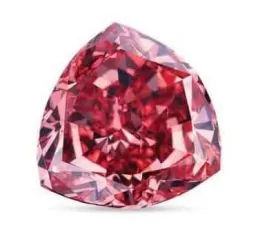
The largest known red diamond is the Moussaieff Red, a 5.11 carat triangular brilliant cut sourced from Brazil in the 1990s and certified Fancy Red by the GIA. The DeYoung Red, 5.03 carats and cut as a round brilliant, lives at the Smithsonian National Museum of Natural History alongside the Hope Diamond. Most red diamonds traded privately today sit well below the 1 carat mark, which is where we tend to focus our Perth client sourcing.

How The Red Colour Forms

A natural red diamond gets its colour from plastic deformation in the diamond’s crystal lattice rather than from trace elements. As the diamond travels through the Earth’s mantle during formation under high temperatures and pressure, the carbon atoms shift along specific crystallographic directions. The resulting distortion in the lattice absorbs green light from the visible spectrum and reflects red back to the eye.

The deformation often appears as parallel bands inside the diamond when viewed under magnification, which is one of the markers a gemologist looks for when authenticating a red stone. Red diamonds can be modified by orange, brown and purple secondary hues. This is the same mechanism that produces pink diamonds; the distinction is intensity. Pink stones carry a lighter expression of the deformation effect, while reds carry the deepest possible expression of it.

Where Red Diamonds Come From

Two sources have produced the majority of natural red diamonds in modern memory.

The Western Australian source in the East Kimberley region, operated by Rio Tinto until the 2020 closure, produced the bulk of the modern world’s natural red diamond supply across its operational life. The annual tender released a small parcel of red stones each year, with prices set through closed-bid auction. Several Perth jewellers attended those tenders in person, and a handful of the stones that came down to Western Australia through that route have eventually passed through our Mt Hawthorn studio on their way to private collectors.

The Minas Gerais region of Brazil has historically produced occasional natural red diamonds, including the Moussaieff Red. Brazilian production has been intermittent rather than steady, and most Australian-traded red inventory today still traces back to the East Kimberley.

With the Australian mine closed, the supply of newly mined natural red diamonds has effectively ended. The category now trades as a closed pool of existing inventory, with prices firming each year as the pool shrinks.

Grading Red Diamonds

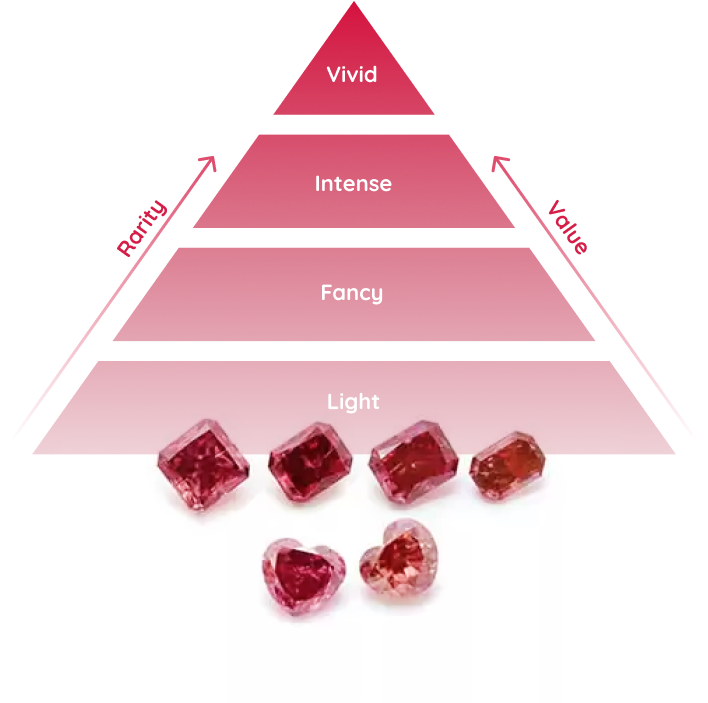
The Gemological Institute of America grades natural red diamonds on the standard fancy colour scale used for all coloured diamonds, with attributes for hue, tone and saturation. The intensity grades for the red category are Fancy Red as the top tier, with Fancy Deep, Fancy Intense and Fancy Vivid applied to modified colours such as purplish red. Pure Fancy Red without modifiers commands the highest prices per carat by some distance.

A certified natural red diamond carries full GIA documentation including the unique laser inscribed serial on the girdle, the colour grade, the modifier, the clarity grade and the carat weight. For Australian-origin stones, additional documentation tracing the diamond back to its source adds significant value in the secondary market. We will not sell a red diamond without complete certification, and we walk through each certificate in person at the studio with the stone in front of you.

Famous Red Diamonds Worth Knowing

The Moussaieff Red, 5.11 carats and Fancy Red, set the auction record for any red diamond when it sold privately in 2001 for approximately USD 8 million. The Hancock Red, 0.95 carats of Fancy Purplish Red, sold at Christie’s in 1987 for USD 880,000, setting a then-record per-carat figure that helped draw the global market’s attention to the category. The Kazanjian Red, 5.05 carats and Fancy Red, has changed hands several times across the past century with one of the more storied provenance histories in private collection.

In November 2017, a 2.11 carat Fancy Red from the Western Australian source sold at the annual tender for an undisclosed but significant sum, reportedly above USD 6 million. That sale was a benchmark for what the WA source could produce at the upper end before its closure, and Perth dealers tracked the figure closely.

The Investment Case For Red Diamonds

Red diamonds carry one of the strongest structural supply stories in the entire coloured gemstone market. The supply is finite and shrinking. Demand is consistent from collectors and high-net-worth investors globally. The category has historically outperformed broader diamond and gemstone benchmarks.

That said, red diamonds are an illiquid investment. The market for stones at the upper end is small, the transaction fees can be significant, and selling a red diamond at full value typically requires the right buyer at the right time. Investment in red diamonds suits long-hold strategies of ten years or more rather than short-term capital deployment.

For Perth clients building a coloured diamond portfolio, we usually recommend treating red diamonds as the apex of a broader pink, purple and red strategy rather than a standalone allocation. The pink diamond market is larger, more liquid, and the price points are more accessible; the appreciation pattern has been similar across the past two decades. Most of our investment-grade pink clients eventually add a red stone when the right one becomes available, and that has been the entry point into the category for a meaningful share of the Perth collectors we work with.

Frequently Asked Questions

It depends heavily on grade, carat weight and modifier. A 0.20 carat Fancy Purplish Red can sit in the AUD 50,000 to 150,000 range. A 0.50 carat pure Fancy Red moves into seven-figure territory. The upper end scales rapidly with size.

Yes. Red diamonds are the rarest of all natural diamond colours, with fewer than 30 pure red stones of meaningful size known to exist worldwide. Pink diamonds are extraordinarily rare in their own right, but roughly an order of magnitude more available than reds.

Yes, under specific compliance rules. The stone must be stored in an approved secure facility, never worn personally, and held as an investment asset within the fund. We can advise on the structure and refer to specialist SMSF financial advisers.

Through GIA certification including the colour grade, modifier and laser-inscribed serial on the girdle. We share the certificate before any sale is finalised. Additional supplier documentation tracing the stone back to the East Kimberley source adds further authentication value for Australian-origin red diamonds.

Yes. The CAD review and final approval stage is the lock-in point before any metal is cast. No production starts until you have signed off on the specifications.

View Red Diamond Stock At Our Studio

If a red diamond is on your shortlist for a portfolio addition or a once-in-a-lifetime commission, we welcome you in for a private viewing at our Mt Hawthorn studio. The supply is small, the available inventory changes by the month, and the right stone for your brief may take time to source through our specialist dealer network. Sometimes the wait is months. The stones tend to be worth it.

View Red Diamond Stock At Our Studio at 145 Scarborough Beach Road, Mt Hawthorn, or call us on (08) 9481 0548 to arrange a private appointment.

Contact Us

If you would like to get in touch please complete the form below.

  • Monday – Friday: 9:30 – 5PM Saturday: 9:30am – 4pm